
Categoría: Organizaciones
Fake Internet leaders
In the last weeks, I have seen ads by companies who claim to be worldwide head-hunters, networks challenging Linkedin and some other Internet giants. A few moments ago, I was seeing the «Linkedin made in Spain».
The homepage design can be carefully crafted and someone could think that the place is so important as they say to be. However, the imposture is so easy to discover that, surprisingly, people still try to fake its real importance in Internet.
An example: Trying to test if «Linkedin made in Spain» is so important as they say, I wrote its Web address in Alexa. These are the results compared with the real Linkedin:
Quantitative Results:
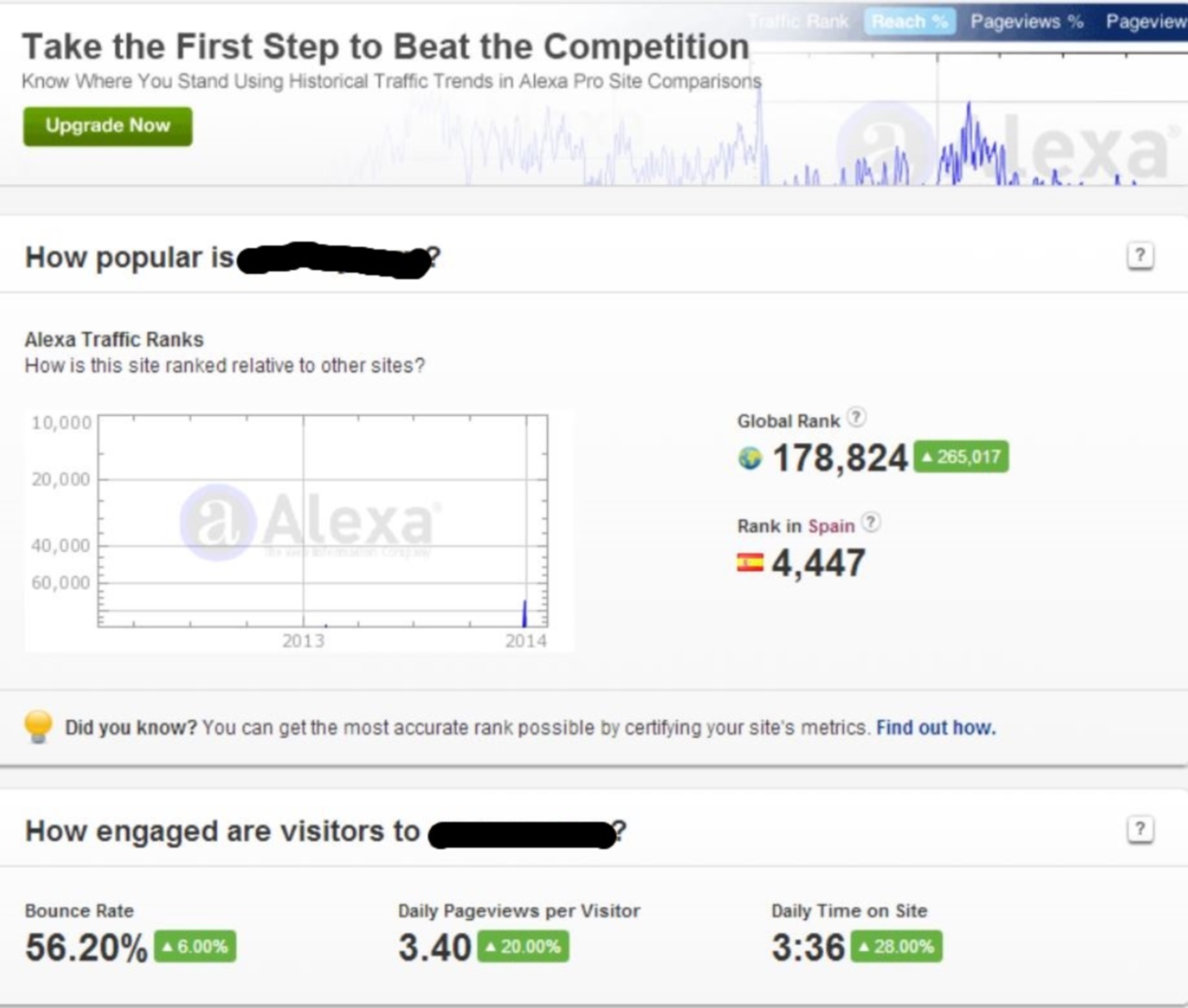
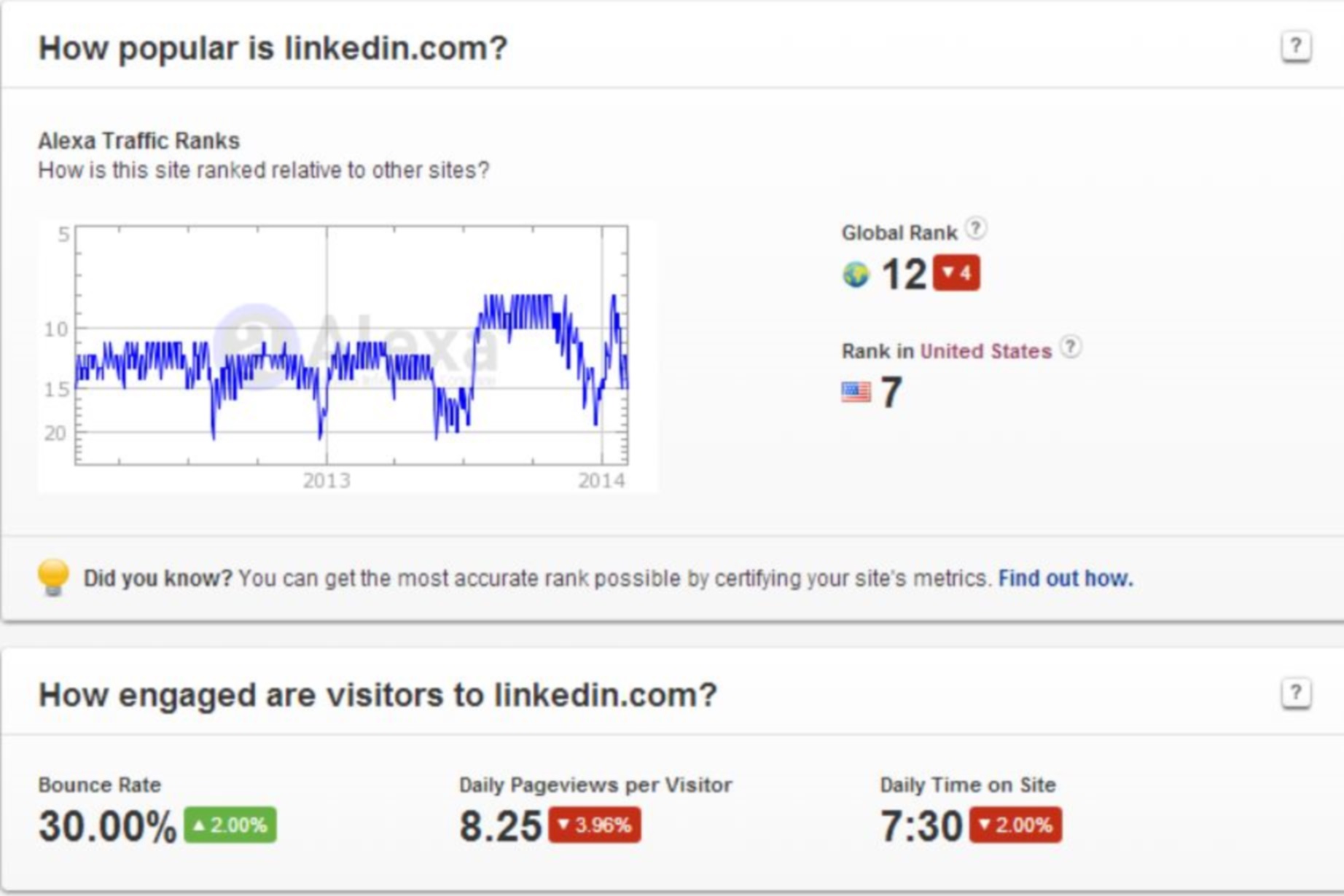
The rank for Linkedin in Spain is 9th, from the same source.
Now, a qualitative vision from Alexa:
Qualitative Results:
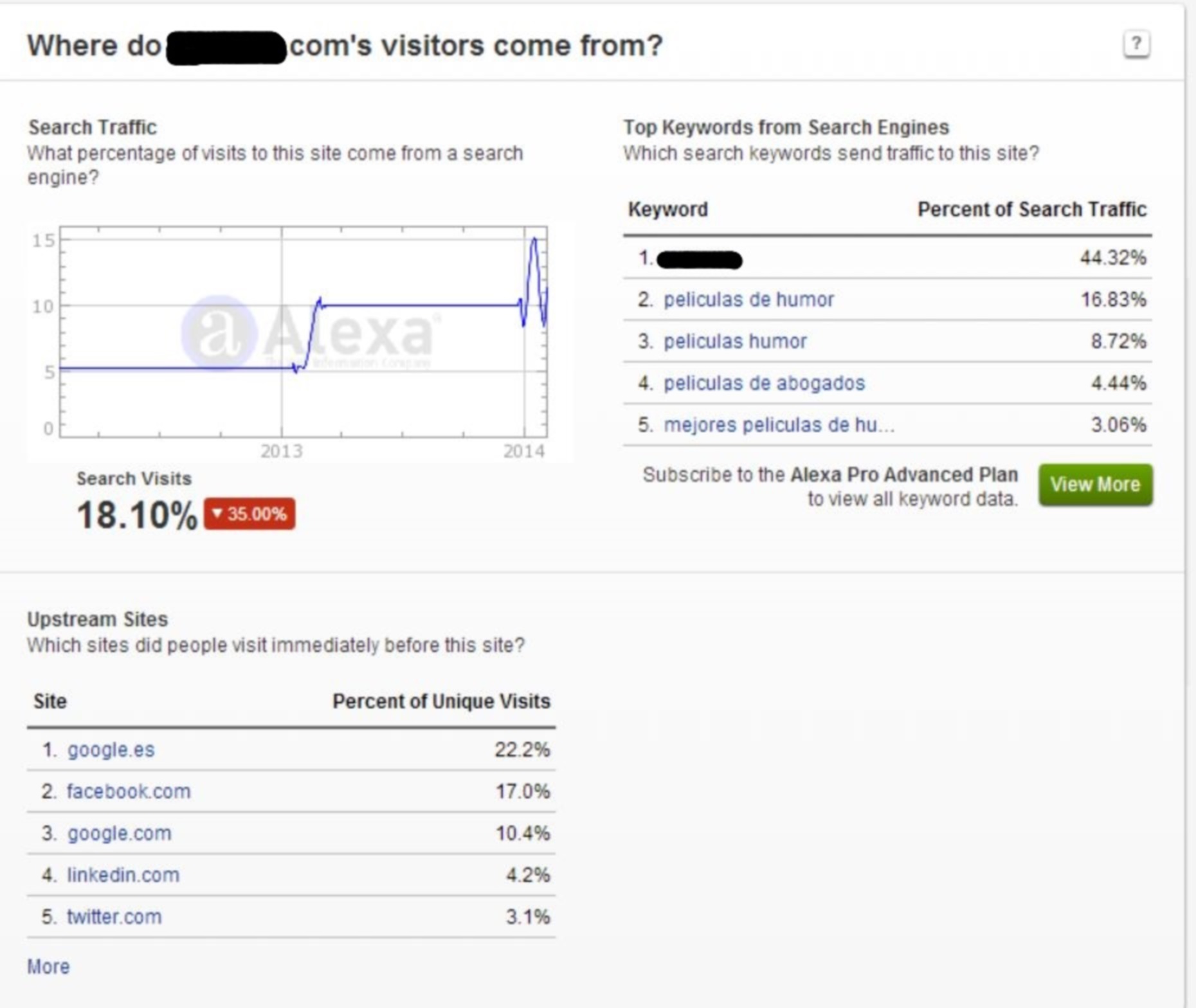
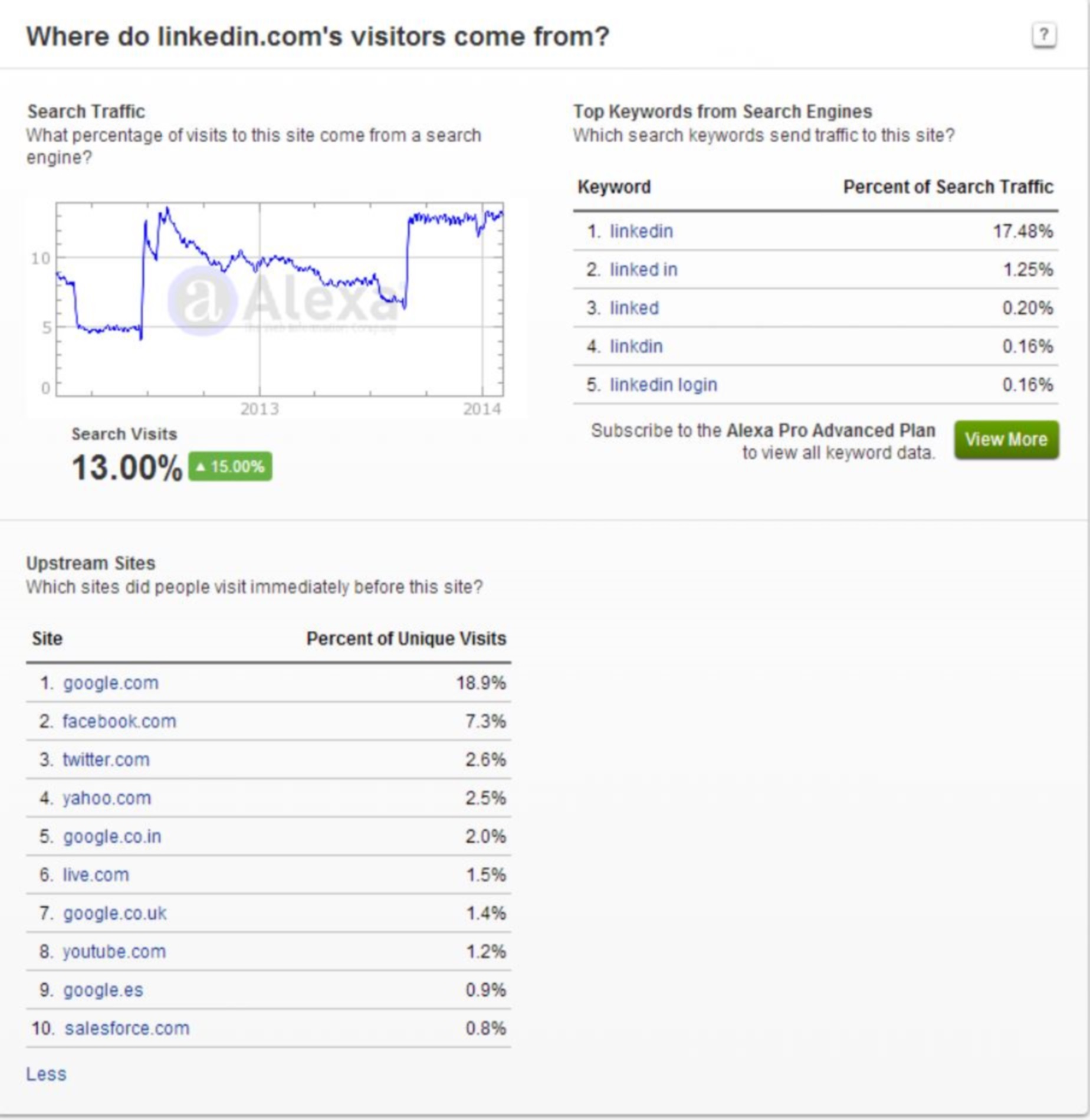
These are the easy-to-obtain data. Please, before playing Internet tycoon remember: Fakes are easy to discover.
Un camello es un caballo diseñado por un comité
Lo confieso: Siempre que se habla de «trabajo en equipo» me echo mano a la cartera porque, demasiado a menudo, en lugar de tratar de sacar lo mejor de todos los miembros se trata de cómo lograr la «aprobación por aclamación», como ocurría en España en las cortes de Franco y en buena medida también ahora.
Un ejemplo sencillo ya comentado en este blog: El caso Nokia. Cualquier observador interesado, sin acceso a información privilegiada ni a costosos gabinetes encargados de producir laboriosos estudios con gran aparato estadístico, vio que la alianza con Microsoft, sin dejarse siquiera una puerta abierta a Android como hicieron otras marcas, era un error garrafal…cualquiera menos, naturalmente, los directivos de Nokia que tomaron la decisión. ¿Eran tontos o incompetentes? La verdad es que no lo creo; sin embargo, es muy probable que la dinámica de toma de decisiones de su organización haya hecho que se comportasen como si lo fueran.
No es el único caso de error fácilmente reconocible en el momento en que se produce -después es mucho más fácil y todos lo reconocemos- y debería ser una invitación a revisar los mecanismos de decisión de muchas organizaciones: La discrepancia está mal vista y, ante esto, muchos directivos «prudentes» prefieren acomodarse en su butaca de cubierta en el Titanic antes de correr el riesgo de perderla si exponen con claridad su desacuerdo.
Si la conducta esperable en un Comité de Dirección es la de un rebaño, y esta conducta se reproduce en los niveles inferiores de la organización, mejor que no llamemos a eso trabajo en equipo y menos aún que cantemos sus excelencias. Algo se está haciendo muy mal. El «Nos encontrábamos al borde del abismo pero hemos dado un paso al frente con decisión» parece la norma en muchas organizaciones…reflexión, poca y, si es grupal, ninguna pero eso sí, mucha decisión…aunque sea para vernos todos al fondo del abismo.
¿Puede un líder ganar su reconocimiento no ejerciendo como tal?
Una pregunta previa: ¿Has visto el final del Concierto de Año Nuevo con la Marcha Radetzky?
Sin duda, este año ha ocurrido algo totalmente anómalo: Mientras sonaba la música, excepto un momento al final, el director, Daniel Barenboim, se dedicó a saludar a todos los músicos de la orquesta: http://youtu.be/P9A0cWAm70Q . La marcha, como siempre, sonó extraordinariamente pero el director estaba otra cosa.
No es el primero que hace algo parecido pero sí el que lo hace durante más tiempo. Hace unos años, Carlos Kleiber, quien tiene con la Filarmónica de Berlín una de las mejores versiones grabadas que pueden encontrarse de la Séptima de Beethoven, tuvo momentos en que, simplemente, se apoyaba en la barra y quedaba, como un espectador más, disfrutando de la música.
Para poner ambas actuaciones, la de Kleiber y sobre todo la de Barenboim, en contexto hay que entender cómo funciona la Filarmónica de Viena: Entre su ya largo anecdotario, figura la ocasión en que se fue la luz y la orquesta siguió tocando para, a continuación, preguntarse los músicos si el director habría seguido dirigiendo. Para los músicos de esta excepcional orquesta, un buen director es visto como un «colega» y no como alguien que se sitúe en un plano superior.
Barenboim, al no dirigir la marcha Radetzky y mostrarlo de forma ostentosa, quiso dar un reconocimiento público a la orquesta en una actuación y en un momento de ésta de especial significado. Sin duda, esa prueba de confianza le habrá ganado, si no la tenía ya antes, la categoría de «colega» y el deseo por parte de los miembros de la orquesta de brillar al máximo cada vez que Barenboim se coloque frente a ellos. Que, además, Barenboim sea capaz de decir que el mejor Concierto de Año nuevo «ha sido y será» uno que fue dirigido por Karajan no le sitúa en un plano inferior. Todo lo contrario. Una lección que sería interesante que aprendieran muchos dirigentes políticos y empresariales.
Aeropuerto de Barajas: ¿A qué imb…esto, experimentado gestor, se le ocurrió esta idea?
La verdad…ya toca bastante las narices que, cuando buena parte de los billetes son tasas aeroportuarias, además haya que pagar por los carros de equipaje. Lamentablemente, éste es un tipo de robo que se encuentra extendido por los aeropuertos de todo el mundo.
Sin embargo, en Barajas han inventado algo nuevo: Usted puede llegar de fuera de su país -algo común en los aeropuertos- e incluso de fuera de la zona euro -también bastante común- para encontrarse con que, para conseguir un carro de equipaje, tiene que comprar una ficha con una moneda de un euro.
Veamos: Puesto que las monedas metálicas no tienen valor de cambio, puede esperarse que el viajero que llega lleve consigo tarjetas de crédito y billetes de euros pero, salvo que haya salido de viaje tres días antes, NO va a llevar monedas de euro. Éste fue nuestro caso, viniendo cargados de equipaje hasta las cejas y, tras dos meses fuera de España, viendo cómo nos las arreglábamos para conseguir una moneda de un euro.
Cierto que, al contrario que en Estados Unidos, en Europa no existen billetes de euro pero nada impide tener la posibilidad de recoger billetes o tarjetas de crédito y, en el primer caso, devolver monedas pero ¿pedir monedas, recién llegado y cuando ni siquiera se ha pasado por las oficinas de cambio? ¿Nadie ha caído en ese insignificante detalle? ¿A qué IMBÉCIL se le ocurrió la idea?
When Profits and Safety are in different places: An historic approach to Aviation
All of us heard that Aviation is the safest Transportation way. That is basically true but, if 94% of accidents happen while on ground or near to ground, we should think that some flight phases have a risk level to be studied.
It’s true that some activities bring an intrinsic risk and Safety means balancing acceptable risk level .vs. efficiency. Aviation is in that common situation but it has its own problems: The lack of an external assessment made the safety-related decisions to be inside a little group of manufacturers, regulators and operators. Consumers listen the mantra “Aviation is the safest Transportation way” but they cannot know if some decisions could drive Aviation to leave that privileged position.
A little summary of technology evolution in the big manufacturers could show how and why some decisions were made and how, in the best possible scenario, these decisions meant losing an opportunity to improve safety level. In the worst one, they should mean a net decrease in safety level:
Once jets appeared, safety increased as a consequence of higher engines reliability. At the same time, navigation improvements like ground-based stations (VOR-DME), inertial systems and, later, GPS appeared too.
However, at the same time that these and other improvements appeared, like making zero visibility landings possible, some other changes whose contribution could be considered as negative appeared too.
One of the best known cases is the engines number, especially in long haul flights. Decades ago, the standard practice for transoceanic flights was using four engine planes. The only exceptions were DC-10 and Lockheed Tristar with three engines. However, in places like U.S.A., long flights where, if required, planes could land before their planned destination, were performed by big planes with only two engines.
Boeing, one of the main manufacturers, would use this fact to say that engines reliability could allow transoceanic flights with twin planes. Of course, maintaining two engines is cheaper than maintaining four and, then, operators should have a strong incentive to embrace the Boeing position but…can we say that crossing an Ocean with two engines is as safe as doing it with four engines, keeping the remaining parameters constant?
Intuition says that it’s not true but messages trying to oppose this simple fact started to appear. Among them, we can hear that a twin modern plane is safer than a four-engine old plane. Nobody said that, if so, the parameter setting safety level should be how old the plane was. Then, the right option should be…a modern plane with four engines.
Airbus, the other big manufacturer, complained because at that moment did not have its own twin planes to perform transoceanic flights but, some time after, they would accept this option starting their own twin planes for these long haul flights. This path –complain followed by acceptance and imitation- has been repeated regarding different issues: One of the manufacturers proposes an efficiency improvement, “its” regulator accepts the change asking for some improvements and the other manufacturer keeps complaining until the moment they have a plane that can compete in that scenario.
In the specific case about twin engines, regulators imposed a rule asking the operators to keep a certain distance from airports that could be in their way. That made twin planes design longer routes and, of course, that meant time and fuel expenses. However, since statistical information showed that engines reliability is very high, the time span allowed to fly with only one engine working while loaded with passengers was increasing until the present situation. Now, we have planes that are certified to fly with only one engine working until arriving to the nearest airport…assuming that it could be 5 hours and a half far. Is that safe?
We don’t really know how safe it is. Of course, it is efficient because that means that a twin engine certified in that way can fly virtually through any imaginable route. Statistics say that it’s safe but the big bulk of data about reliability does not come from laboratories but from flying planes and that’s where statistics could fail: Engines reliability makes that big amount of data come from flights where both engines have been working in uneventful flights. We can add that twin planes have more remaining power than four-engine planes due to the exigence that, if an engine fails after a moment during take-off, the plane has to be able to take-off with only one engine. Of course, the four-engine plane has to be able to perform this action with three engines, not with one.
In other words, during cruise time, the engines of a twin plane work in a low effort situation that, of course, can have a favorable impact in reliability. The question that statistical reports could not address because of lack of the right sample should be: Once one engine failed, the remaining one starts to work in a much more exigent situation. Does it keep the same reliability level that it had while both engines were working? Is that reliability enough to guarantee the flight under these conditions for more than 5 hours? Actually, the lack of a definitive answer to this question made the regulators to ask for a condition instead: The remaining engine should not get out of normal parameters while providing all the required power to keep the plane airborne.
At least, we could have some doubts about it but, since the decision was made among “insiders” without any kind of external check, nobody questioned it and, nowadays, the most common practice at boarding a transoceanic flight, is doing it in a twin plane. We will attend to the masks and lifejackets show but it’s unlikely that some could say:
“By the way, the engines in this plane are so reliable that, in the very unlikely event that one of them fails, we can fly with full safety with the remaining one until reaching the nearest airport, no more than 5 hours and a half far”.
How many users are informed about this little detail with they board a plane with the intention of crossing an Ocean? This is only and example because it’s not the only field where improvement followed by complains and acceptance was the common behavior.
Engines number is an issue especially visible –for obvious reasons- but a similar case can be observed in matters like codkpit crewmembers decrease or automation. Right now, there is not a single passengers plane from any of the big manufacturers bringing flight engineer. In this case, Airbus was the innovator in its A310 model and, like in the engines issue, we could ask if removing the flight engineer has made Aviation more or less safe.
Boeing was the one complaining in this case but…it happened to be designing its models 757 and 767 that, in the final configuration, would be launched without a flight engineer.
Is a flight engineer important for safety? Our starting point should be a very easy one: The job of a pilot does not know the concept of “average workload”. It goes from urgencies and stress to boredom and viceversa. In a noneventful flight overflying an Ocean and without traffic problems, there are not many things to do. The plane can fly without a flight engineer and even without pilots. They remain in their place “just-in-case”, that is, in a situation quite similar –with some differences- to the one we can find in a firemen place. However, when things become complex, there is a natural división of tasks: One of the pilots flies the plane while the other one takes care of navigation and communications and, if there is a serious technical problem, they have to try to fix it…it seems that someone is missing.
This absence was very clear in 1998 in Swissair-111, where a cabin smoke situation should make a MD-11, without a flight engineer, crash. In a few moments, they passed from an uneventful flight prepared to cross Atlantic Ocean to a burning hell where they had to land in an unknown airport, to find the place and runways orientation, radio frequencies…while keeping the plane controlled, throwing fuel and trying to know the origin of the fire to extinguish it.
The accident research, performed by “insiders” did not address this issue. Two people cockpit was already considered as a given, even though another almost identical plane –DC10- with flight engineer could have invited them to make the comparison. Of course, nobody can say that having a flight engineer should have saved the plane but the workload that pilots confronted should have been far lower.
This issue was not addressed neither when a plane from Air Transatt landed at Azores islands with both engines stopped. That happened because they were losing fuel and a wrong fuel management made the pilots transfer fuel to the tank that was losing it. Should it have happened if someone had been devoted to analyze carefully fuel flow and how the whole process was working? Perhaps not but this scenario was simply ignored.
Flight engineers dissappeared because automation appeared and that started a new problem: Pilots started to lose skills for manual flying and it drove to a situation named “automation paradox”:
Automation gets an easier user interface but this is a mirage: A cockpit with less controls and cleaner from a visual scope does not mean that the plane is simpler. Actually, it’s a much more complex plane. For instance, every Boeing 747 generation has been decreasing the number of controls in the cockpit. Even though, newer planes are more complex and that’s how the automation paradox works:
Training is centered in interface design instead of internal design. That’s why we find planes more and more complex and users who know less and less about them. A single comparison can be made with Windows systems, almost universal in personal IT. Of course, it allows much more things than the old DOS but…DOS never got blocked. Unlike DOS, Windows is much more powerful but, if blocked, the user does not have available options.
The question should be if we can admit a Windows-like system in an environment where risk is an intrinsic part of the activity. The system allows more things and can be properly managed without being an expert but, if it fails, there are not options for the average user.
“Fly-by-wire” system was introduced by Airbus in commercial Aviation, with the Concorde exception, and it confronted complains from Boeing. We have to say that Boeing had a high experience in fly-by-wire systems because of its military aircrafts. Again, we find a situation where efficiency is bigger even though some pilots complain about facts like losing kinestesic feeling. In a traditional plane, a hand on the controls can be enough to know how the plane is flying and if there is a problem with speed, center of gravity and others. In fly-by-wire planes, by default, this feeling does not exist (Boeing kept it in its planes but, to do so, they had to “craft” the feeling since the controls by themselves don’t not provide it).
This absence could partially explain some major accidents, labeled “Human Error” or “Lack of Training” without anybody analyzing what features of the design could drive to an error like, for instance, a defective sensor triggering an automatic response without the pilots knowing what’s going on.
What is the situation right now? If we check the last planes from the big manufacturers, we can get some clues: Boeing 787 .vs. Airbus A350. Both are big twin and long-haul planes, there is not a flight engineer, they are highly automated and they both have fly-by-wire system. Coincidence? Not at all. Through a dynamic of unquestionned changes agreed by insiders and without knowledge by the consumers, the winner will be always the most efficient solution. Then, both manufacturers finished with two models that share a good part of the philosophy. There are differences –electric .vs. hydraulic controls, feeling .vs. no-feeling from the controls, more or less use of composite materials, lithium .vs. traditional batteries…- but the main parameters are the same.
Issues that were discussed time ago are seen as already decided. The decision always favored the most efficient option, not the safest one. Could that be changed? Of course, but it’s not possible if everything keeps working as an “insiders game” instead of giving clear and transparent information outside.
We should understand too the position of «insiders»: A case like GermanWings was enough for some people -like NYT- to question the plane before knowing what really happened. A few days ago, we had an accident with a big military plane manufactured by Airbus and some people started already to question the safety of a single manufacturer…perhaps someone near to the other one?
Information has to flow freely but, at the same time, many people make a living from scandal and it’s hard to find the right point: Truth and nothing but the truth and, at the same time, deactivate the ones who want to find or manufacture a scandal. Nowadays, the environment is very closed and in that environment efficiency will have always the upper hand…even in cases where it shouldn’t. By the other side, we have to be careful enough to address real problems instead of invented ones. The examples used here can be illustrated not only with the referenced cases but with some others whose mention has been avoided.
Air Safety and low-cost
Low-cost started as an almost marginal issue but, nowadays, some low-cost airlines have outgrown their traditional competitors. Of course, something like that does not happen by chance. A high growth rate for many years usually points to a serious business project. In this context, «serious» means the opposite to a «take the money and run» model, so common in many activities, including Aviation.
Then, we should start with this fact: There are low-cost operators that did not come looking for easy money. This fact, evident in the behavior of some operators, asks for an analysis where respect is deserved and it is not going to be denied here.
Once made clear that we do not speak about people looking for easy model, the business model linked to low-cost shows itself as very interesting, not only because of results but because of eventual hidden weaknesses. We’ll center our analysis in safety and potential impact over safety of low-cost practices:
First, a little bit of common sense: If an operator wants to get better prices, costs are the enemy to beat and safety can be translated into costs. Furthermore, since yield-management appeared, it is hard finding two passengers in a plane who have paid the same for their tickets and, whatever traditional operators can tell us, it is a way to sell below costs to beat low-cost operators with not-so-deep pockets. In this environment, differences in prices have to be really important to resist this kind of competition.
Common sense tells us, also, that decreasing costs in safety can be a hard-to-resist temptation. However, this should be a conclusion that requires a deeper analysis:
Low-cost operators are very conscious that this an easy to reach conclusion and, if true, it can damage them very seriously.
When someone notoriously better known than popular like Michael O’Leary, Ryanair CEO was asked for the risks in the Ryanair business model, he was quite explicit: The risk of making something stupid from our side or an accident in an important low-cost operator.
The investigation after an accident can discover inadequate practices in any airline. However, a low-cost operator has a different risk level: Inadequate practice, if discovered, should not be read in terms of negligence or error but as an usual practice to decrease costs and, hence, as a part of their business model.
Hence, low-cost operators are fully conscious that a single major accident can put at risk their business continuity at a bigger level than the one who should suffer traditional operators. They have tried to minimize this risk in different ways and with different success levels:
Public Relations people from low-cost operators tell anyone willing to listen to them that they are controlled under the same rules that every other. Of course, this statement tries to put in the mind of the listener the idea that they have the same safety level that any other. This statement is true but, without entering in the real capacity of rulemakers and inspectors, can be deactivated with a simple example: Rules for car-makers are the same. Does it mean that a Dacia Logan offers the same safety level that an Audi A8 since both share the same rules?
When there is a serious business project and, of course, big low-cost operators have it, safety cannot be reduced to craft ingenious slogans but has to go much further:
Southwest Airlines, still the most copied model among low-cost operators, based cost reduction in a very specific operating objective: 25 minutes from landing to take-off. This objective has to be hard to reach since other operators, like Jet-Blue, decide to leave it looking for the cost reduction in other places.
Southwest based this objective in a very deep knowledge by every single worker about how his activity was affecting others. Without trying the everyone makes everything started by People Express and hard to keep in the long term, Southwest kepts specialization but, at the same time, created an environment based in the ability of the workers performing the job to detect improvement opportunities.
Ryanair trajectory has been much tougher: Time between flights is only one of the ways to reduce costs. Many others, like who pays the uniform of the workers or the invitation to grab ballpoints from the hotel rooms or the price paid by the new recruits for the privilege of working there…Probably, O’Leary himself should not be offended if defined like a CFO that became CEO because since he is fully conscious of that.
O’Leary is so conscious of his importance in Ryanair as financial watchdog that he decided not to attend meetings where maintenance decisions are made. The decision, together with having someone with high technical profile as the Maintenance Head, is positive but it should be quite reasonnable asking ourselves if that is enough. It is extremely hard creating watertight compartments in any organization and, in this case, it seems that they try to create such a watertight compartment to have Maintenance out of pressure looking for cost reduction in any area in the organization.
However, it is easy forgetting that safety is not a function but a perspective covering all the operations in the organization. If an organization is known for a very specific perspective -cost reduction- asking what will happen when both perspectives clash is a must.
As an example, it is possible deciding to have a good spare parts stocks but, in a cost-reduction driven organization…what should happen if a maintenance work is delayed beyond expectations? what should happen if a pilot put more fuel than stricly legal requirements? what if a pilot, already delayed, does not want to speed-up tasks or make checklists faster than usual? We could find hundred of examples of clashing perspectives and, of course, having Maintenance isolated from cost decrease pressure is not enough. If lowering costs is the dominant perspective, that is something that will be over every decision that someone can take as well in a cockpit as in any other position. That, of course, will affect the real safety level that someone can reach.
Low-cost operators are in the market time enough to be able to make differences among them. Possibly, a soft model, like the Southwest one, centered in cost-reduction in very specific ways, will be less sensible to safety issues than other operators more hard-nosed. These ones will pursue costs wherever they are to exterminate them and this attitude can drive them very often to conflict of perspectives.
For good of all of stake-holders, including passengers, it should be good for the most aggresive companies in their cost-reduction practices to be able to solve the organizational problem that two conflicting perspectives bring, especially if one of them has always the winning hand.
The challenge will not be easy and it is going to require from very imaginative and energetic operators at least so much imagination and energy as the one they devoted to cost reduction and, perhaps, it will make them change some habits that they see as very important since they were an important part of their success.
We will know if they are successful in this effort or if they will make good the Drucker statement success makes obsolete the factors that made it possible. If so, the factor that could be obsolete even though it drove to the past success is precisely the fundamentalism in cost reduction. Fundamentalism, in this context, should be understood in its most literal meaning: Invasion of fields that are not theirs.
Human Resources and Mathematical Fictions
It is hard to find more discussed and less solved issues than how to quantify Human Resources. We have looked for tools to evaluate jobs, to evaluate performance and at what percentage objectives were met. Some people tried to quantify in percentage terms how and individual and a job fit and, even, many people tried to obtain the ROI over training. Someone recovered Q index, aimed to quantify speculative investments, to convert it into the main variable for Intellectual Capital measurement, etc..
Trying to get everything quantified is so absurd as denying a priori any possibility of quantification. However, some points deserve to be clarified:
New economy is the new motto but measurement and control instruments and, above all, business mentality is defined by engineers and economists and, hence, organizations are conceived as machines that have to be designed, adjusted, repaired and measured. However, it is a common fact that rigor demanded about meeting objectives is not used in the definition of the indicators. That brought something that is called here Mathematical Fictions.
A basic design principle should be that any indicator can be more precise than the thing it tries to indicate whatever the number of decimal digits we could use. When someone insists in keeping a wrong indicator, consequences appear and they are never good:
- Management behavior is driver by an indicator that can be misguided due to sneaky type of the variable supposedly indicated. It is worth remembering what happened when some Governments decided that the main priority in Social Security was reducing the number of days in waiting lists instead of the fluffy “improving Public Health System”. A common misbehavior should be to give priority to less time consuming interventions to reduce the number of citizens delaying the most importan tones.
- There is a development of measurement systems whose costs are not paid by the supposed improvement to get from them. In other words, control becomes an objective instead of a vehicle since control advantages do not cover costs of building and maintenance of the control. For instance, some companies trying to control abuse in photocopies ask for a form for every single photocopy making the control much more expensive than the controlled resource.
- Mathematical fictions appear when some weight variables that, in the best situation, are only useful for a situation and lose its value if the situation changes. Attemps relative to Intellectual Capital are a good example but we commit the same error if we try to obtain percents of people-job adjustment to use them as to foresee success in a recruiting process.
- Above all, numbers are a language that is valid for some terrains but not for others. Written information is commonly rejected with “smart talk trap” arguments but the real fact is that we can perceive fake arguments easier in written or verbal statements than if they come wrapped in numbers. People use to be far less exigent about indicators design than about written reports.
- Even though we always try to use numbers as “objective” indicators, the ability to handle these numbers by many people is surprisingly low. We do not need to speak about the journalist that wrote that Galapagos Islands are hundreds of thousands of kilometers far from Ecuador coast or the common mistake between American billion or European billion. We can show two easy examples about how numbers can lose any objectivity due to bad use:
After the accident of Concorde in Paris, 2001, media reported that it was the safest plane in the world. If we consider that, at that time, only fourteen planes of the type were flying instead of the thousands of not-so-exclusive planes, it is not surprising that an accident never happened before and, hence, nobody can say from it to be the safest plane. The sample was very short to say that.
Another example: In a public statement, the Iberia airline said that travelling by plane is 22 times safer than doing it by car. Does it mean that a minute spent in a plane is 22 times safer than a minute spent in a car? Far from it. This statement can be true or false depending of another variable: Exposure time. A Madrid-Barcelona flight lasts seven times less than a trip by car. However, if we try to contrast one hour inside a plane with an hour inside a car, results could be very far from these 22 times.
The only objective of these examples is showing how numbers can mislead too and we are less prepared to detect the trick than when we have to deal with written language.
These are old problems but –we have to insist- that does not mean they are solved and, perhaps, we should to arrive to the Savater idea in the sense that we do not deal with problems but with questions. Hence, we cannot expect a “solution” but contingent answer that never will close forever the question.
If we work with this in mind, measurement should acquire a new meaning. If we have contingent measurements and we are willing to build them seriously and to change them when they become useless, we could solve some –not all of them- problems linked to measurement. However, problems will arise when measurement is used to inform third parties and that could limit the possibility to change.
An example from Human Resources field can clarify this idea:
Some years ago, job evaluation systems had a real crisis. Competencies models came from this crisis but they have problems to for measurement. However, knowing why job evaluation systems started to be displaced is very revealing:
Even though there are not big differences among the most popular job evaluation systems, we will use Know-How, Problem Solving and Accountability, using a single table to compare different jobs in these three factors is brilliant. However, it has some problems hard to avoid:
- Reducing to a single currency, the point, all the ratings coming from the three factors implies the existence of a “mathematical artifact” to weight the ratings and, hence, priming some factors over others.
- If, after that, there are gross deviations from market levels, exceptions were required and these go directly against one of the main values that justified the system: Fairness.
Although these problems, job evaluation systems left an interesting legacy not very used: Before converting ratings into points, that is, before starting mathematical fictions, we have to rate every single factor. We have there a high quality information, for instance, to plan professional paths. A 13 points difference does not explain anything but a difference between D and E, if they are clearly defined, are a good index for a Human Resources manager.
If that is so…why is unused this potential of the system? There is an easy answer: Because job evaluation systems have been used as a salary negotiation tool and that brings another problem: Quantifiers have a bad design and, furthermore, they have been used for goals different from the original one.
The use of mix comittees for salary bargaining, among other factors, has nullified the analytical potential of job evaluation systems. Once a job is rated in a way, it is hard to know if this rating is real or it comes from the vagaries of the bargaining process.
While job evaluation remained as an internal tool of Human Resources area, it worked fine. If a system started to work poorly, it could be ignored or changed. However, if this system starts to be a main piece in the bargaining, it losses these features and, hence, its use as a Human Resources tool dissapears.
Something similar happens if we speak about Balanced Scorecard or Intellectual Capital. If we analyze both models, we’ll find that there is only a different variable and a different emphasis: We could say, without bending too much the concepts, that the Kaplan and Norton model is equal to Intellectual Capital plus financial side but there is another difference more relevant:
Balanced Scorecard is conceived as a tool for internal control. That implies that changes are easy while Intellectual Capital was created to give information to third parties. Hence, measurement has to be more permanent, less flexible and…less useful.
Actually, there are many examples to be used where the double use of a tool nullifies at least another one. The same idea of “Double Accounting” implies criticism. However, pretending that a system designed to give information to third parties can be, at the same time and with the same criteria, an effective tool for control, is quite near to ScFi.
Competencies systems have too its own part of mathematical fiction. It is hard to créate a system able to capture all the competencies and to avoid overlapping among them. If this is already hard…how is it possible to weight variables to define job-occupant adjustment? How many times are we evaluating the same thing under different names? When can we weight a competence? Is this value absolute or should it depend on contingencies? Summarizing….is it not a mathematical nonsense aimed to get a look of objectivity and, just-in-case, to justify a mistake?
This is not a declaration against measurement and, even less, against mathematics but against the symplistic use of it. “Do it as simple as possible but no more” is a good idea that is often forgotten.
Many of the figures that we use, not only in Human Resources, are real fiction ornated with a supposed objectivity coming from the use of a numeric language whose drawbacks are quite serious. Numeric language can be useful to write a symphony but nobody would use it to compose poetry (except if someone decides to use the cheap trick of converting letters into numbers) and, however, there is a general opinion about numbers as universal language or, as Intellectual Capital starters said, “numbers are the commonly accepted currency in the business language”.
We need to show not only momentaneous situations but dynamics and how to explain them. That requires written explanations that, certainly, can misguide but, at least, we are better equipped to detect it than if it come wrapped in numbers.
Lessons from 11S about Technology
Long time ago, machines started to be stronger and more precise than people. That is not new but…are they smarter too? We can forget developments near to SciFi like artificial intelligence based in quantum computing or interaction among simple agents. Instead, we are going to deal with present technology, its role in an event like 11S and the conclusions that we can get from that.
Let’s start with a piece of information: A first generation B747 plane required three/four people in a cockpit with more than 900 elements. A last generation B747 only requires two pilots and the number of elements inside the cockpit decreased in two thirds. Of course, this has been posible through I.T. introduction and, as a by-product, rhrough automation of tasks that, previously, had to be performed manually. The new plane appears as easier than the old one. However, the amount of tasks that the plane performs now on its own makes it a much more complex machine.
Planes used in 11S could be considered as state-of-the-art planes at that time and this technological level made the fact possible, of course, together with a number of things far from technology. Something like 11S should have been hard with a less advanced plane. Handling old planes is harder and the collaboration of pilots in a mass-murder should have been required. Not an easy task getting the collaboration of someone in his own death under death threat.
The solution was making the pilot expendable and that, if the plane is flying, requires another pilot willing to take his own life. How is the training cost for that pilot? In money terms, a $120.000 figure could be more less adjusted if speak about training a professional pilot. However, this could not be hard to get for the people that organized and financed 11S. A barrier harder to pass is the time required for this training. Old planes were very complicated and their handling required a good amount of training to be acquired along several years. Should terrorists be so patient? Could they trust in the commitment of future self-killers along the years?
Both questions could invite the organizers to reject the plans as unfeasible. However, technology played its role in a very easy way: Under normal situations, modern planes are easier to handle and, hence, they can be flown by people less knowledgeable and less expert. Coming from this point, situation appears under a different light: How long it takes for a rookie pilot getting the dexterity required to handle the plane at the level required by the objectives? Facts showed the answer: A technologically advanced passenger plane is easy to handle –at the level required- by a low-experienced pilot after an adaption through simulator training.
Let’s go back to the starting question: Machines are stronger and more precise than people. Are they smarter too? We could start discussing the different definitions about intelligence but, anyway, there is something that machines can do: Once a way to solve a problem is defined, that way can be programmed into a machine to get the problem automatically solved once and again. As a consequence, there is displacement of complexity from people to the machine, allowing modern and complex machines to be handled by people less able than former machines with more complex interfaces.
Of course, there is an economic issue here: An important investment in technological design can be recovered if the number of machines sharing the design is high enough. Investment in design is made only once but it can drive to important savings in thousands of pilots training. At this moment, automation paradox appears: Modern designs produce more complex machines with a good part of the tasks automated. Automation makes these machines easier to handle under normal conditions than the previous ones. Hence, less trained people can operate machines that, internally, are very complex. Once complexity is hidden at interface level, less trained people can drive more complex machines and that is the place where automation payback is.
The scaring question is this one: What happens in unforeseen situations and, hence, not included in technological design? If we speak about high risk activities, the manufacturer uses to have two answers to this questions: Redundancy and manual handling. However, both possibilities require a previous condition: The problem has to be identified as such in a clear and visible way. If not or if, even after being identified, the problem appears in a situation where there is not available time, people trained to operate the machine can find that the machine “becomes crazy” without any clue about the causes of the anomalous behavior.
Furthermore, if the operator receives a full training, that is, not only related with interface but related with the knowledge of the principles of internal design, automation could not be justified due to increased training costs. We already know the alternative: The capacity to answer to an unforeseen event is seriously jeopardized. 11S is one of the most dramatic tests about how people with low training can perform tasks that, before, should have required more training. However, this is not an uncommon situation and it is nearer to our daily life than we could suspect.
Everytime we have a problem in the phone, an incidence with the Bank, an administrative problema in the gaz or electricity bill…we can start a process calling the Customer Service. How many times, after bouncing from one Department to other, someone tells us that we have to dial the number that we had dialed at the beginning? Hidden under these experiences, there is a technological development model based in complex machines and simple people. Is this a sustainable model? Technological development produce machines harder and harder to understand by their operators. In that way, we make better and better things that we already knew how to do and things that already were hard become harder and harder.
11S was possible, among other things, as a consequence of a technological evolution model. This model is showing to be exhausted and requiring a course change. Rasmussen stated the requirements of this course change under a single condition: Operator has to be able to run cognitively the program that the machine is performing. This condition is not met and, in case of being mandatory, it could erase the economic viability driving to a double challenge: One of them should be technological making technology understandable to users beyond operating level under known conditions and the other one is organizational avoiding the loss of economic advantages..
Summarizing, performing better in things that we already performed well and, to do that, performing worse in things that we already were performing poorly is not a valid option. People require answer always, not only when automation and I.T. allow it. Cost is the main driver of the situation. Organizations do not answer unforeseen external events and, even worse, complexity itself can produce events from inside that, of course, do not have an answer neither.
A technological model aimed to make easier the “what” hiding the “why” is limited by its own complexity and it is constraining in terms of human development. For a strictly economic vision, that is good news: We can work with less, less qualified and cheaper people. For a vision more centered in human and organizational development, results are not so clear. By one side, complexity puts a barrier preventing the technological solution of problems produced by technology. By other side, that complexity and the opacity of I.T. make the operators slaves without the opportunity to be freed by learning.
Accidente de Santiago: Declaraciones del maquinista
Tras el accidente de Santiago de Compostela, debo encontrarme entre los pocos españoles que no son especialistas en trenes. Sin embargo, sí estoy suficientemente familiarizado con los factores humanos y con la seguridad para encontrar cosas que me sorprenden en las declaraciones publicadas del maquinista implicado en el accidente:
- Cuando el juez le pregunta si pueden recorrerse cuatro kilómetros distraído, la respuesta del maquinista es de puro sentido común: “A 200 kms./h. cuatro kilómetros pasan muy deprisa”. Cierto. A 240 kms./h. cuatro kilómetros pasan exactamente en un minuto.
Tras esta respuesta, alguien podría pensar que, si va completamente distraído mientras conduce durante todo un minuto, seguramente acabará fuera de la carretera y tendrá razón: Eso ocurre en la carretera; no ocurre en los trenes, al igual que no ocurre en los barcos o en los aviones y eso nos debería dar una primera pista:
La carretera exige del conductor una mayor atención al entorno y un cierto nivel de actividad debido a la necesidad de seguir el trazado, de anticiparse a situaciones relacionadas con el tráfico, etc. Sin embargo, en otros medios de transporte lo que se exige, salvo en determinados momentos, es mantenerse alerta para supervisar el funcionamiento del vehículo que se va controlando. En aviación, se ha criticado con frecuencia a los sistemas muy automatizados que mantengan al piloto fuera del “loop de control” o, en otros términos, que el avión vuela solo pero, cuando algo ocurre, se requiere la intervención urgente de alguien cuya función era estar ahí “por si acaso”.
Si en algo estamos de acuerdo todos los que, de una u otra manera, trabajamos en factores humanos es en el hecho de que somos unos pésimos supervisores. No estamos “diseñados” para supervisar sino para hacer. Cuando alguien nos pone a supervisar, es inevitable que surjan las distracciones y los fallos de atención; éste es un hecho muy conocido en aviación pero su aplicación no es exclusiva de este ámbito.
- Cuando el juez le pregunta si existe un sistema de frenado automático, el maquinista responde que en esa zona es él el que frena y no un sistema automático. Al repetirle la pregunta, insistiendo en saber qué es lo que ocurriría si el maquinista no frena en el punto en que debería llega la sorpresa: Si va por encima de 200 kms./h. el tren pondría en marcha todos los dispositivos de frenado automáticamente hasta detenerse pero, si va por debajo de 200 kms./h., no pasa nada. La curva del accidente está limitada a 80 kms./h.¿Sirve de algo una protección automática que sólo funciona cuando se circula a más de 200 kms./h.? La respuesta la tenemos en los periódicos de los días pasados y el video en Youtube.
No hay término medio válido aquí. Si se asume que el maquinista es un mero vigilante, dótese a la línea y al tren de sistemas automáticos que impidan situaciones como la que produjo el accidente de Santiago y asumamos que el maquinista se va a distraer, como lo hacemos todos cuando estamos en tarea de vigilancia porque, una vez más, no estamos hechos para vigilar sino para hacer.
Si se asume que el maquinista tiene un papel más activo, diséñense trenes que exijan ese papel más activo. Los aviones a prueba de fallos de pilotos y los trenes a prueba de fallos de maquinistas también traen sus propios problemas, a veces en forma de falta de realismo sobre cuáles son las cosas que hacemos bien y cuáles las que hacemos mal.
Maquinistas y pilotos: Factores humanos en trenes y aviones
El terrible accidente de tren de Santiago de Compostela ha puesto, una vez más, encima de la mesa el asunto del error humano que, en este caso, se ha revestido desde el principio del concepto de imprudencia.
Sinceramente, siempre desconfío del diagnóstico de “error humano” como causa de un accidente. Existen tanto en aviación como en ferrocarril como en cualquier otro ámbito muchos y poderosos intereses que invitan a utilizar al maquinista o al piloto como una especie de fusible de forma que el sistema, y los que lo dirigen, queden fuera de todo escrutinio.
Cuando alguien decreta que un 90% de los accidentes se producen por fallo humano, cabe pensar si, con ello, quiere evitar que se mire más arriba del maquinista o del piloto o de quien, en última instancia, haya tenido la mala suerte de estar más cerca del accidente.
Dicho esto, y una vez explicados mis motivos para la desconfianza, es cierto que la realidad suele ser muy terca y que las imprudencias existen: Las personas no somos máquinas y podemos decidir en un momento dado comportarnos en forma imprudente. Por supuesto, aunque la imprudencia tenga consecuencias profesionales, penales o incluso se pague con la vida propia y ajena, el análisis no puede detenerse ahí: ¿Es la primera vez o hay indicios de que tal actuación se venía repitiendo en el tiempo? Si había indicios ¿Por qué no se detectaron? ¿Es posible o deseable utilizar protecciones tecnológicas? ¿El lugar o la situación eran intrínsecamente peligrosos y estábamos ante un accidente en busca de la oportunidad para producirse?
La situación que hoy se nos plantea en el tren de Galicia, al menos con lo que conocemos hasta ahora, se produjo hace cinco años en un accidente de aviación: El vuelo 518 de Santa Bárbara Airlines. El avión despegó de una zona montañosa de Colombia, Mérida, para estrellarse minutos después del despegue en territorio venezolano.
La investigación posterior mostró que los pilotos se llevaron el avión al aire en la forma que la mayoría nos llevamos un coche: Girando la llave de contacto y marchándonos. Los pilotos conocían muy bien la zona; la conocían tan bien que despegaron sin dar tiempo a que funcionasen los giróscopos en que se basa el sistema de navegación y se metieron en terreno montañoso, sin visibilidad y sin más referencia que la brújula del avión. El registro de voces en cabina daría lugar a indicios de que no era la primera vez que los pilotos actuaban de esta forma; simplemente, esta vez les salió mal y nadie sabía que estaba ocurriendo y, si alguien lo sabía, una vez ocurrido el accidente optó por callarse para no ser acusado de permitir tal práctica.
¿Imprudencia clara? Sin duda; sin embargo, incluso en este caso, hay que analizar si era detectable, si era evitable y si, una vez cometida, se podían contener sus efectos. Cuando se habla de trenes, siempre hay una ventaja sobre los aviones: Se hace difícil pensar en efectos negativos para la seguridad de cualquier protección tecnológica que detenga o disminuya la velocidad del tren en caso de error o violación del maquinista; esto no ocurre en aviación donde las protecciones tecnológicas asumen que se está produciendo una situación y, si no es ésa la situación o algún sensor falla, la protección puede convertirse en el causante directo del accidente.
¿El trazado es inadecuado? Es posible pero, a la escasa distancia que se encontraba la curva de Santiago de Compostela, si el tren pasaba por ella a 190 kms./h. ¿dónde pensaba frenar?
¿Iba el maquinista descansado o tras varias horas se llevan los raíles y las traviesas clavados en la retina y se tiene una propensión al error que no se tiene al principio de un viaje?
Son muchas preguntas las que hay que responder todavía pero, desde la desconfianza ya apuntada hacia todo diagnóstico que pretenda dar carpetazo con el sello “error humano”, tiene que haber también un reconocimiento de que la imprudencia sin paliativos también existe. ¿Es éste el caso del tren de Santiago de Compostela? Hoy aún no podemos saberlo. Confiemos en que, cuando lleguemos al final de la investigación, los intereses no han prevalecido sobre la verdad. Las víctimas siempre se merecen que se llegue a la verdad, caiga quien caiga, tanto si tiene que ser un maquinista como si tiene que ser un ministro.


Debe estar conectado para enviar un comentario.