
Categoría: Gestión de conocimiento
Sterile discussions about competencies, Emotional Intelligence and others…
When «Emotional Intelligence» fashion arrived with Daniel Goleman, I was among the discordant voices affirming that the concept and, especially, the use of it, was nonsense. Nobody can seriously reject that personal features are a key for success or failure. If we want to call it Emotional Intelligence that’s fine. It’s a marketing born name not very precise but, anyway, we can accept it.
However, losing the focus is not acceptable…and some people lose the focus with statements like «80% of success is due to Emotional Intelligence, well above the percentage due to «classic» intelligence. We lose focus too with statements comparing competencies with academic degress and the role of each part in professional success. These problems should be analyzed in a different and simpler way: It’s a matter of sequence instead of percentage.
An easy example: What is more important for a surgeon to be successful? The academic degree or the skills shown inside the OR? Of course, this is a tricky question where the trick is highly visible. To enter the OR armed with an scalpel, the surgeon needs an academic recognition and/or a specific license. Hence, the second filter -skills- is applied over the ones who passed the first one -academic recognition- and we cannot compare in percentage terms skills and academic recognition.
Of course, this is an extreme situation but we can apply it to the concepts where some sterile discussions appear. Someone can perform well thank to Emotional Intelligence but the entrance to the field is guaranteed with intelligence in the most common used meaning. Could we say that, once passed an IQ threshold we should better improve our interaction skills than -if possible- improve 10 more IQ points? Possibly…but things don’t work that way, that is, we define the access level through a threshold value and performance with other criteria, always comparing people that share something: They all are above the threshold value. Then…how can I say «Emotional Intelligence is in the root of 80% of success»? It should be false but we can convert it into true by adding «if the comparison is made among people whose IQ is, at least medium-high level». The problem is that, with this addition, it is not false anymore but this kind of statement should be a simple-mindedness proof.
We cannot compare the relative importance of two factors if one of them is referred to job access while the other is referred to job performance once in the job. It’s like comparing bacon with speed but using percentages to appear more «scientific».
Internet y su presunta omnisciencia: La próxima guerra está en la calidad de la información
Ray Kurzweil decía que la gran revolución que han traído los sistemas avanzados de información está en un simple hecho: Reproducir y transmitir la información tiene un coste virtualmente igual a cero. Se supone que eso significa romper una diferenciación clásica entre los que tienen acceso a la información y los que no la tienen puesto que, según Kurzweil, ahora todos lo tienen.
Por puro azar, estos últimos días he tenido que buscar información sobre distintos temas y, cómo no, he recurrido a hacer búsquedas más o menos avanzadas en Google y en sitios que se suponen especializados en proveer información. Tengo que anticipar que no se trataba de cuestiones filosóficas, religiosas o similares sino de preguntas que tienen una respuesta clara . Otra cosa es acceder a ella a través de la maraña de informaciones falsas o desfasadas. Esto ocurre incluso cuando se trata de asuntos directamente relacionados con Internet.
Ejemplo: Teléfono Nexus 5 con el compromiso de actualización por parte de Google a la última versión de Android. Lo que no dice Google es cuándo llega esa última versión y, los que somos poco pacientes, buscamos otras vías como, por ejemplo, descargar la actualización oficial de los sitios de Google. Esto requiere cierta manipulación en el teléfono como desbloquear el bootloader o rootear el teléfono u otras piezas de la tecnoverborrea.
En cualquiera de estas opciones, Google ofrece varias páginas de resultados, incluyendo videos de Youtube. El problema está cuando se intenta poner en práctica y se ve que las instrucciones pueden ser desfasadas, incompletas o, simplemente, el teléfono no hace lo que, según las instrucciones leídas en Internet, tendría que hacer.
Lo curioso del caso es que, después de tratar diversas soluciones y en alguna de éllas llegar a bloquear el terminal, apareció una solución: Una herramienta software llamada Nexus Root Toolkit que permite al usuario hacer lo que quiera con el teléfono: Rootear, desrootear, bloquear o desbloquear el bootloader, cambiar la versión del sistema operativo…lo que sea.
¿Por qué llegar a esta herramienta supone una peregrinación y un ensayo y error de soluciones que supuestos o reales expertos van poniendo en Internet?
Otro ejemplo, quizás algo menos escandaloso porque no va al propio terreno en el que se supone que Internet debería tener información de primera calidad, está en la búsqueda de diferencias en el diseño entre dos tipos de avión y en temas muy específicos: La información existe pero encontrarla con un buscador o en un sitio de preguntas y respuestas tipo Quora es prácticamente imposible y al final lo más operativo es telefonear a alguien que se sabe que dispone de tal información…como en los viejos tiempos.
Kurzweil tiene razón: La gran revolución de la tecnología de la información es la desaparición del coste de multiplicar y transmitir información pero esa gratuidad virtual ha traído consigo un problema: Todo el mundo tiene un altavoz sobre cualquier tema y no sólo los que tengan algo que decir sobre él. Encontrar una señal válida entre una masa creciente de ruido es cada vez más difícil y el aumento de número de páginas o de velocidades de acceso no sólo no arreglan este problema sino que contribuyen a agravarlo.
Internet crece de una forma espectacular pero la calidad de la información que contiene no lo hace. Más bien lo contrario.
Windows Knowledge
Perhaps in a moment where Microsoft does not live its best moment, speaking about Windows could be seen as a paradox. However, Windows itself is a paradox of the kind of knowledge that many companies are pricing right now.
Why Windows? You open your computer to find a desktop. The desktop has binders and documents and you have even a trash bin. This environment allows working in the old-fashioned way. We move documents from one binder to another one. When a document is not useful anymore, we put it in the trash bin and everything seems to be perfect…as far as everything works as it’s supposed to work. What happens when we find a blue screen or, simply, the computer does not start?
At that moment, we find that everything was false. Desktop, binders, documents…? Everything is false. Everything is a part of a complex metaphor, good while everything works as expected but fully useless once something fails. What kind of real knowledge does the Windows user have? The Windows user has an operating knowledge that can be enough in more than 90% of the cases. That’s fine if the remaining 10% cannot bring unexpected and severe consequences but we see this kind of knowledge in more and more places, including critical ones.
When 2008 crisis started, someone said that many Banks and financial institutions had been behaving as Casinos. Other people, more statistically seasoned denied that telling that, had they been behaving as Casinos, the situation never should have been as it was because Casinos have probabilities in their favor. Other environments don’t have this advantage but they behave as if they have it with unforeseeable consequences.
BIG DATA: WILL IT DELIVER AS PROMISED?
The Big Data concept is still relatively new but the concept inside is very old: If you have more and more data, you can eliminate ambiguity and there are less requirements of hunches since data are self-explanatory.
That is a very old idea coming from I.T. people. However, reality always insisted in delaying the moment when that can be accomplished. There are two problems to get there:
- As data grow, it is more necessary a context analysis to decide which one are relevant and which others can be safely ignored.
- At the other side of the table, we could have people trying to misguide automatic decision supporting systems. Actually, the so-called SEO (Search Engine Optimization) could be properly renamed GAD (Google Algorithm Deception) to explain more clearly what it is intended to do.
Perhaps, by now, Big Data could be less prone to the second problem than anyone performing Web Analytics. Web has become the battlefield for a quiet fight:
By one side, the ones trying to get better positions for them and the positive news about them. These are also the ones who try to hide negative news throwing positive ones and repeating them to be sure that the bad ones remain hidden in search results.
By the other side, we have the Masters of Measurement. They try to get magic algorithms able to avoid tricks from the first ones, unless they decide paying for their services.
Big Data has an advantage over Web data: If a company can have its own data sources, they can be more reliable, more expensive to deceive and any attempt could be quite easily visible. Even though, this is not new: During the II World War, knowing how successful a bombing had been was not a matter of reading German newspapers or listening to German radio stations.
The practice known as content analysis used indirect indicators like funerals or burials information that could be more informative if and only if the enemy did not know that these data were used to get information. In this same context, before D-Day, some heavily defended places with rubber-made tanks tried to fool reconnaissance planes about the place where the invasion was to start. That practice has remained for a long time. Actually, it was used even in the Gulf War, adding to the rubber tanks heat sources aimed to deceive infrared detectors, who should get a similar picture to the one coming from running engines.
Deceiving Big Data will be harder than deceiving Internet data but, once known who is using specific data and what is doing with them, there will be always a way to do this. An easy example: Inflation indicators: A Government can decide changing the weight in the different variables or changing prices of Government-controlled prices to get a favorable picture. In the same way, if Big Data is used to give information to external parties, we should not need someone from outside trying to deceive the system. That should be done from inside.
Anyway, the big problem is about the first point: Data without a context are worthless…and the context could be moving faster than any algorithm designed to give meaning to the data. Many surprising outcomes have happened in places where all the information was available. However, that information has been correctly read only after a major disaster. For instance, emergence of new political parties could be seen but, if major players decided to dismiss them, it comes as a surprise for them, even though data were available. The problem was in the decision about what deserves to be analyzed and how to do it, not in the data themselves.
Other times, the problem comes from fast changes in the context that are not included in the variables to analyze. In the case of Spain, we can speak about the changes that 11M, and how it was managed by the different players, supposed in the election three days after. In another election, everybody had a clear idea about who was going to get a position that required an alliance. Good reasons advised an agreement and data showed that everybody was sure that the agreement was coming…but it wasn’t. One of the players was so sure that things were already done that tried to impose conditions that the other players saw as unacceptable. Consequence: The desired position was to the hands of a third player. Very recently, twopeople, both considered as growing stars, can have spoiled their options in minor incidents.
In short, we can have a huge amount of data but we cannot analyze all of them but the ones considered as relevant. At doing that, there is not an algorithm or an amount of data that can be a good replacement for an analysis performed by human experts. An algorithm or automatic system can be fooled, even by another automatic system designed to do that, context analysis can lose important variables that have been misjudged and sudden changes in the context cannot be anticipated by any automatic system.
Big Data can be helpful if rationally used. Otherwise, it will become another fad or worse: It could become a standard and nobody would dare deciding against a machine with a lot of data and an algorithm, even when they are wrong.
Frederick W. Taylor: XXI Century Release
Any motivation expert, from time to time, devotes a part of his time to throw some stones to Frederick W. Taylor. It seems, from our present scope, that there are good reasons for the stoning: Strict splitting between planning and performing is against any idea considering human beings as something more than faulty mechanisms.
However, if we try to get the perspective that Taylor could have a century ago, things could change: Taylor made unqualified workers able to manufacture complex products. These products were far beyond the understanding capacity of those manufacturing them.
From that point of view, we could say that Taylor and his SWO meant a clear advance and Taylor cannot be dismissed with a high-level theoretical approach out of context.
Many things have happened since Taylor that could explain so different approach: The education of average worker, at least in advanced societies, grew in an amazing way. The strict division between design and performance could be plainly justified in Taylor time but it could be nonsense right now.
Technology, especially the information related, not only advanced. We could say that it was born during the second half of the past century, well after Taylor. Advances have been so fast that is hard finding a fix point or a context to evaluate its contribution: When something evolves so fast, it modifies the initial context and that removes the reference point required to evaluate the real value.
At the risk of being simplistic, we could say that technology gives us «If…Then» solutions. As technology power increases, situations that can be confronted through an «If…Then» solution are more and more complex. Some time ago, I received this splendid parody of a call-center that shows clearly what can happen if people work only with «If…Then» recipes, coming, in this case, from a screen:
http://www.youtube.com/watch?v=GMt1ULYna4o
Technology evolution again puts the worker -now with an education level far superior to the one available in Taylor age- in a role of performer of routines and instructions. We could ask why so old model is still used and we could find some answers:
- Economics: Less qualified people using technology can perform more complex tasks. That means savings in training costs and makes turnover also cheaper since people are easier to replace.
- Knowledge Ownership: People have a brain that can store knowledge. Regretfully, from the perspective of a company, they have also feet that can be used to bring the brain to other places. In other words, knowledge stored by persons is not owned by companies and, hence, they could prefer storing knowledge in processes and Information Systems managing them.
- Functionality: People commit more mistakes, especially in these issues hard to convert into routines and required going beyond stored knowledge.
These points are true but, when things are seen that way, there is something clear: The relation between a company and people working there is strictly economical. Arie de Geus, in The living organization, said that the relation between a person and a company is economic but considering it ONLY economic is a big mistake.
Actually, using If…Then model as a way to make people expendable can be a way to guarantee a more relaxed present situation…at the price of questionning the future. Let’s see why:
- If…Then recipes are supplied by a short number of suppliers working in every market and, of course, having clients who compete among them. Once reduced the human factor to the minimum…where is it going to be the difference among companies sharing the same Information Systems model?
- If people are given stricly operative knowledge…how can we advance in this knowledge? Companies outsource their ability to create new knowledge that, again, remains in the hands of their suppliers of Information Systems and their ability to store more «If…Then» solutions.
- What is the real capacity of the organization to manage unforeseen contingencies, if they have not been anticipated in the system design or, even worse, contingencies coming from the growing complexity of the system itself?
This is the overview. Taylorism without Taylor is much worse than the original model since it’s not justified by the context. Companies perform better and better some things that they already knew how to manage and, at the same time, it is harder and harder for them improving at things that previously were poorly performed. People, under this model, cannot work as an emergency resource. To do this, they need knowledge far beyond the operative level and capacity to operate without being very constrained by the system. Very often they miss both.
Jens Rasmussen, expert in Organization and Safety, gave a golden rule that, regretfully, is not met in many places: Operator has to be able to run cognitively the program that the system is performing. Features of present Information Systems could allow us working under sub-optimized environments: Instead of an internal logic that only the designer can understand -and not always- things running and keeping the Rasmussen rule would be very different.
The rationale about training and turnover costs would remain but advantages from ignoring it are too important to dismiss them. The sentence of De Geus is real and, furthermore, it has a very serious impact about how our organizations are going to be in the next future.
Un camello es un caballo diseñado por un comité
Lo confieso: Siempre que se habla de «trabajo en equipo» me echo mano a la cartera porque, demasiado a menudo, en lugar de tratar de sacar lo mejor de todos los miembros se trata de cómo lograr la «aprobación por aclamación», como ocurría en España en las cortes de Franco y en buena medida también ahora.
Un ejemplo sencillo ya comentado en este blog: El caso Nokia. Cualquier observador interesado, sin acceso a información privilegiada ni a costosos gabinetes encargados de producir laboriosos estudios con gran aparato estadístico, vio que la alianza con Microsoft, sin dejarse siquiera una puerta abierta a Android como hicieron otras marcas, era un error garrafal…cualquiera menos, naturalmente, los directivos de Nokia que tomaron la decisión. ¿Eran tontos o incompetentes? La verdad es que no lo creo; sin embargo, es muy probable que la dinámica de toma de decisiones de su organización haya hecho que se comportasen como si lo fueran.
No es el único caso de error fácilmente reconocible en el momento en que se produce -después es mucho más fácil y todos lo reconocemos- y debería ser una invitación a revisar los mecanismos de decisión de muchas organizaciones: La discrepancia está mal vista y, ante esto, muchos directivos «prudentes» prefieren acomodarse en su butaca de cubierta en el Titanic antes de correr el riesgo de perderla si exponen con claridad su desacuerdo.
Si la conducta esperable en un Comité de Dirección es la de un rebaño, y esta conducta se reproduce en los niveles inferiores de la organización, mejor que no llamemos a eso trabajo en equipo y menos aún que cantemos sus excelencias. Algo se está haciendo muy mal. El «Nos encontrábamos al borde del abismo pero hemos dado un paso al frente con decisión» parece la norma en muchas organizaciones…reflexión, poca y, si es grupal, ninguna pero eso sí, mucha decisión…aunque sea para vernos todos al fondo del abismo.
Artificial Intelligence (GOFAI): Story of an old mistake
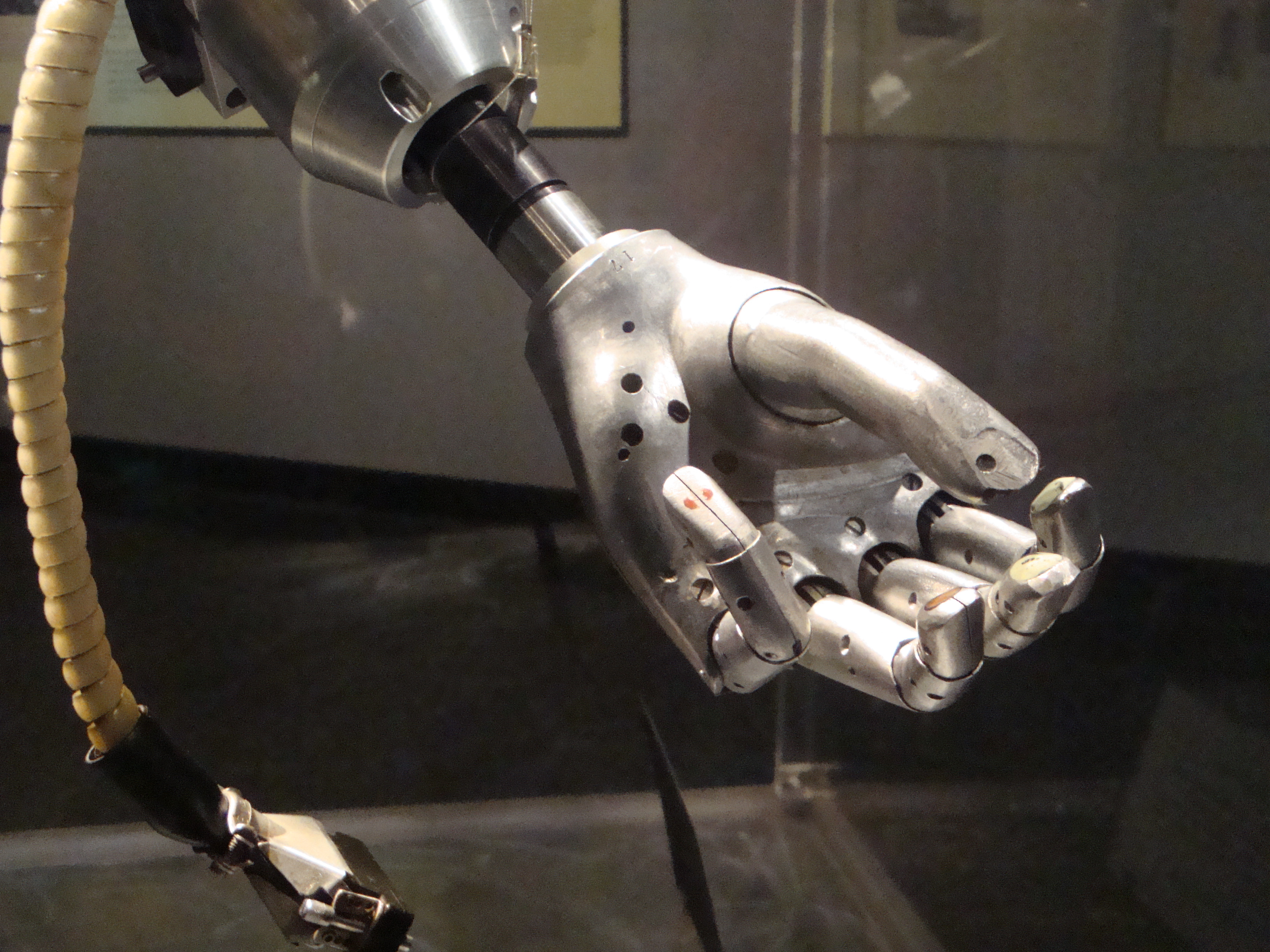
Is there something surprising in this picture? Anyone familiar with robot arms can be surprised by the almost human looking of this hand, quite uncommon in robots used in manufacturing and surgery. A robot hand does not try to imitate the external shape of a human hand. It usually has two or three mobile pieces working as fingers. However, we have in the picture a copy of a human hand. Now, the second surprise: The picture is taken from a design in the M.I.T museum and whose author is Marvin Minsky.
Anything wrong with that? Minsky reigned for years in the I.A. activity in M.I.T. and one of his principles, as told by one of his successors, Rodney Brooks, was this: When we try to advance at building Intelligent Machines, we are not interested at all about human brain. This is the product of an evolution that, probably, left non-functional remains. Therefore, it is better starting from scratch instead of studying how a human brain works. This is not a literal sentence but an interpretation that can be made, from their own writings, about how Minsky and his team could think about Artificial Intelligence.
We cannot deny that, thinking this way, they have a point and, at the same time, an important confusion: Certainly, human brain can have some parts as a by-product from evolution and these parts could not add anything to its right performance. Moreover, these parts could have a negative contribution. However, this is not to be applied only to brain. Human eye has some features that could make an engineer designing a camera with the eye as guide to be immediatly fired. Even though, we do not complain about how the eye works, even if we compare with almost all Animal Kingdom but the comparison should be tricky: Human brain «fills» many of the deficiencies of the eye as, for instance, the blind spot and gives human sight features that are not related with the eye as, for instance, a very advanced ability to detect movements. That ability is related with specialized neurons much more than with the lens (the eye). The paradox: Human hand comes from the same evolutive process that the brain or eye and, hence, it is surprising for someone, who made a basic principle of dismissing human features, to design a hand that imitates a human one far beyond functional requirements.
Confusion in this old I.A. group is between shape and function. They are right: We can have evolutive remains but there is a fact: Neurons, far slower than electronic technology, are able to get results hard to reach for advanced technology in fields as shape recognition or others, apparently as trivial as catching a ball that comes flying. Usually, sportpeople are not seen as a paradigm of cerebral activity but the fact is that movements required to catch a ball, not to say in a highly precise way, are out of reach for advanced technology. Principle based in «evolutive remains» is clear but, if results coming from this pretended defective organ are, in some fields, much better than the ones that we can reach through technology…is it not worth trying to know how it works?
Waiting to have more storing room and more speed is a kind of «Waiting for Godot» or an excuse, since present technology is able to provide products much more faster than the humble neurons and storing capacity has very high limits and it is still growing. Do they need more speed to arrive before someone that is already much slower? Hard to explain.
The same M.I.T. museum where the hand is has a recording where a researcher, working with robot learning, surprises because of her humility: At the end of the recording when she speaks about her work with a robot, she confesses that they are missing something beyond speed or storing capacity. Certainly, something is missing: They could be in the same situation that the drunk looking for a key under a light, not because he has lost there but because that is the only place with light enough to look for something.
I.A. researchers did not stop to think in depth in the nature of intelligence or learning. However, they tried to produce them in their technological creations getting quite poor results, as well in their starting releases as in the ones with features like parallel processing, neuron networks or interaction among learning agents. Nothing remotely similar to an intelligent behavior nor a learning deserving that name.
Is that an impossible attempt? Human essentialists would say so. Rodney Brooks, one of the successors of Minsky sustains the opposite position based in a fact: Human essentialists always said: «There is a red line here impossible to trespass» and technological progress once and again forced them to put the supposed limit further. Brook was right but…this fact does not show at all that a limit, wherever it could be, does not exists as Brooks tries to conclude…that should be a jump hard to justify, especially after series of experiments that never got to show an intelligent behavior and some scientific knowledge in the past had to be changed by a new one. When scientists where convinced about the fat that Earth was flat, navigation already existed but techniques had to change radically after the real shape of Earth was common knowledge. Brooks could be in a similar situation: Perhaps technological progress does not have a known limit but it does not mean that his particular line in this technological progress has a future. It could be one of many cul-de-sac where science has come once and again.
As a personal opinion, I do not discard the feasibility of intelligence machines. However, I discard that they can be built if there is not a clear idea about the real nature of intelligence and what the learning mechanisms are. The not-very-scientific attitudes that the I.A. group showed against «dissidents» drove to dismiss people like Terry Winograd, once his findings made him uncomfortable or others, like Jeff Hawkins, were rejected from the beginning due to his interest about how the human brain works.These and other people like Kurzweil and others could start a much more productive way to study Artificial Intelligence than the old one.
The I.A. past exhibits too much arrogance and, as it happens in many academic institutions, a working style based in loyalties to specific persons and to a model that, simply, does not work. The hand of the picture shows something more: Contradictions with the own thinking. I do not know if an intelligent machine will be real but, probably, it will not come from a factory working with the principle of dismissing anything that they ignore.Finding the right way requires being more modest and being able to doubt about the starting paradigms.
Human Resources and Mathematical Fictions
It is hard to find more discussed and less solved issues than how to quantify Human Resources. We have looked for tools to evaluate jobs, to evaluate performance and at what percentage objectives were met. Some people tried to quantify in percentage terms how and individual and a job fit and, even, many people tried to obtain the ROI over training. Someone recovered Q index, aimed to quantify speculative investments, to convert it into the main variable for Intellectual Capital measurement, etc..
Trying to get everything quantified is so absurd as denying a priori any possibility of quantification. However, some points deserve to be clarified:
New economy is the new motto but measurement and control instruments and, above all, business mentality is defined by engineers and economists and, hence, organizations are conceived as machines that have to be designed, adjusted, repaired and measured. However, it is a common fact that rigor demanded about meeting objectives is not used in the definition of the indicators. That brought something that is called here Mathematical Fictions.
A basic design principle should be that any indicator can be more precise than the thing it tries to indicate whatever the number of decimal digits we could use. When someone insists in keeping a wrong indicator, consequences appear and they are never good:
- Management behavior is driver by an indicator that can be misguided due to sneaky type of the variable supposedly indicated. It is worth remembering what happened when some Governments decided that the main priority in Social Security was reducing the number of days in waiting lists instead of the fluffy “improving Public Health System”. A common misbehavior should be to give priority to less time consuming interventions to reduce the number of citizens delaying the most importan tones.
- There is a development of measurement systems whose costs are not paid by the supposed improvement to get from them. In other words, control becomes an objective instead of a vehicle since control advantages do not cover costs of building and maintenance of the control. For instance, some companies trying to control abuse in photocopies ask for a form for every single photocopy making the control much more expensive than the controlled resource.
- Mathematical fictions appear when some weight variables that, in the best situation, are only useful for a situation and lose its value if the situation changes. Attemps relative to Intellectual Capital are a good example but we commit the same error if we try to obtain percents of people-job adjustment to use them as to foresee success in a recruiting process.
- Above all, numbers are a language that is valid for some terrains but not for others. Written information is commonly rejected with “smart talk trap” arguments but the real fact is that we can perceive fake arguments easier in written or verbal statements than if they come wrapped in numbers. People use to be far less exigent about indicators design than about written reports.
- Even though we always try to use numbers as “objective” indicators, the ability to handle these numbers by many people is surprisingly low. We do not need to speak about the journalist that wrote that Galapagos Islands are hundreds of thousands of kilometers far from Ecuador coast or the common mistake between American billion or European billion. We can show two easy examples about how numbers can lose any objectivity due to bad use:
After the accident of Concorde in Paris, 2001, media reported that it was the safest plane in the world. If we consider that, at that time, only fourteen planes of the type were flying instead of the thousands of not-so-exclusive planes, it is not surprising that an accident never happened before and, hence, nobody can say from it to be the safest plane. The sample was very short to say that.
Another example: In a public statement, the Iberia airline said that travelling by plane is 22 times safer than doing it by car. Does it mean that a minute spent in a plane is 22 times safer than a minute spent in a car? Far from it. This statement can be true or false depending of another variable: Exposure time. A Madrid-Barcelona flight lasts seven times less than a trip by car. However, if we try to contrast one hour inside a plane with an hour inside a car, results could be very far from these 22 times.
The only objective of these examples is showing how numbers can mislead too and we are less prepared to detect the trick than when we have to deal with written language.
These are old problems but –we have to insist- that does not mean they are solved and, perhaps, we should to arrive to the Savater idea in the sense that we do not deal with problems but with questions. Hence, we cannot expect a “solution” but contingent answer that never will close forever the question.
If we work with this in mind, measurement should acquire a new meaning. If we have contingent measurements and we are willing to build them seriously and to change them when they become useless, we could solve some –not all of them- problems linked to measurement. However, problems will arise when measurement is used to inform third parties and that could limit the possibility to change.
An example from Human Resources field can clarify this idea:
Some years ago, job evaluation systems had a real crisis. Competencies models came from this crisis but they have problems to for measurement. However, knowing why job evaluation systems started to be displaced is very revealing:
Even though there are not big differences among the most popular job evaluation systems, we will use Know-How, Problem Solving and Accountability, using a single table to compare different jobs in these three factors is brilliant. However, it has some problems hard to avoid:
- Reducing to a single currency, the point, all the ratings coming from the three factors implies the existence of a “mathematical artifact” to weight the ratings and, hence, priming some factors over others.
- If, after that, there are gross deviations from market levels, exceptions were required and these go directly against one of the main values that justified the system: Fairness.
Although these problems, job evaluation systems left an interesting legacy not very used: Before converting ratings into points, that is, before starting mathematical fictions, we have to rate every single factor. We have there a high quality information, for instance, to plan professional paths. A 13 points difference does not explain anything but a difference between D and E, if they are clearly defined, are a good index for a Human Resources manager.
If that is so…why is unused this potential of the system? There is an easy answer: Because job evaluation systems have been used as a salary negotiation tool and that brings another problem: Quantifiers have a bad design and, furthermore, they have been used for goals different from the original one.
The use of mix comittees for salary bargaining, among other factors, has nullified the analytical potential of job evaluation systems. Once a job is rated in a way, it is hard to know if this rating is real or it comes from the vagaries of the bargaining process.
While job evaluation remained as an internal tool of Human Resources area, it worked fine. If a system started to work poorly, it could be ignored or changed. However, if this system starts to be a main piece in the bargaining, it losses these features and, hence, its use as a Human Resources tool dissapears.
Something similar happens if we speak about Balanced Scorecard or Intellectual Capital. If we analyze both models, we’ll find that there is only a different variable and a different emphasis: We could say, without bending too much the concepts, that the Kaplan and Norton model is equal to Intellectual Capital plus financial side but there is another difference more relevant:
Balanced Scorecard is conceived as a tool for internal control. That implies that changes are easy while Intellectual Capital was created to give information to third parties. Hence, measurement has to be more permanent, less flexible and…less useful.
Actually, there are many examples to be used where the double use of a tool nullifies at least another one. The same idea of “Double Accounting” implies criticism. However, pretending that a system designed to give information to third parties can be, at the same time and with the same criteria, an effective tool for control, is quite near to ScFi.
Competencies systems have too its own part of mathematical fiction. It is hard to créate a system able to capture all the competencies and to avoid overlapping among them. If this is already hard…how is it possible to weight variables to define job-occupant adjustment? How many times are we evaluating the same thing under different names? When can we weight a competence? Is this value absolute or should it depend on contingencies? Summarizing….is it not a mathematical nonsense aimed to get a look of objectivity and, just-in-case, to justify a mistake?
This is not a declaration against measurement and, even less, against mathematics but against the symplistic use of it. “Do it as simple as possible but no more” is a good idea that is often forgotten.
Many of the figures that we use, not only in Human Resources, are real fiction ornated with a supposed objectivity coming from the use of a numeric language whose drawbacks are quite serious. Numeric language can be useful to write a symphony but nobody would use it to compose poetry (except if someone decides to use the cheap trick of converting letters into numbers) and, however, there is a general opinion about numbers as universal language or, as Intellectual Capital starters said, “numbers are the commonly accepted currency in the business language”.
We need to show not only momentaneous situations but dynamics and how to explain them. That requires written explanations that, certainly, can misguide but, at least, we are better equipped to detect it than if it come wrapped in numbers.
Lessons from 11S about Technology
Long time ago, machines started to be stronger and more precise than people. That is not new but…are they smarter too? We can forget developments near to SciFi like artificial intelligence based in quantum computing or interaction among simple agents. Instead, we are going to deal with present technology, its role in an event like 11S and the conclusions that we can get from that.
Let’s start with a piece of information: A first generation B747 plane required three/four people in a cockpit with more than 900 elements. A last generation B747 only requires two pilots and the number of elements inside the cockpit decreased in two thirds. Of course, this has been posible through I.T. introduction and, as a by-product, rhrough automation of tasks that, previously, had to be performed manually. The new plane appears as easier than the old one. However, the amount of tasks that the plane performs now on its own makes it a much more complex machine.
Planes used in 11S could be considered as state-of-the-art planes at that time and this technological level made the fact possible, of course, together with a number of things far from technology. Something like 11S should have been hard with a less advanced plane. Handling old planes is harder and the collaboration of pilots in a mass-murder should have been required. Not an easy task getting the collaboration of someone in his own death under death threat.
The solution was making the pilot expendable and that, if the plane is flying, requires another pilot willing to take his own life. How is the training cost for that pilot? In money terms, a $120.000 figure could be more less adjusted if speak about training a professional pilot. However, this could not be hard to get for the people that organized and financed 11S. A barrier harder to pass is the time required for this training. Old planes were very complicated and their handling required a good amount of training to be acquired along several years. Should terrorists be so patient? Could they trust in the commitment of future self-killers along the years?
Both questions could invite the organizers to reject the plans as unfeasible. However, technology played its role in a very easy way: Under normal situations, modern planes are easier to handle and, hence, they can be flown by people less knowledgeable and less expert. Coming from this point, situation appears under a different light: How long it takes for a rookie pilot getting the dexterity required to handle the plane at the level required by the objectives? Facts showed the answer: A technologically advanced passenger plane is easy to handle –at the level required- by a low-experienced pilot after an adaption through simulator training.
Let’s go back to the starting question: Machines are stronger and more precise than people. Are they smarter too? We could start discussing the different definitions about intelligence but, anyway, there is something that machines can do: Once a way to solve a problem is defined, that way can be programmed into a machine to get the problem automatically solved once and again. As a consequence, there is displacement of complexity from people to the machine, allowing modern and complex machines to be handled by people less able than former machines with more complex interfaces.
Of course, there is an economic issue here: An important investment in technological design can be recovered if the number of machines sharing the design is high enough. Investment in design is made only once but it can drive to important savings in thousands of pilots training. At this moment, automation paradox appears: Modern designs produce more complex machines with a good part of the tasks automated. Automation makes these machines easier to handle under normal conditions than the previous ones. Hence, less trained people can operate machines that, internally, are very complex. Once complexity is hidden at interface level, less trained people can drive more complex machines and that is the place where automation payback is.
The scaring question is this one: What happens in unforeseen situations and, hence, not included in technological design? If we speak about high risk activities, the manufacturer uses to have two answers to this questions: Redundancy and manual handling. However, both possibilities require a previous condition: The problem has to be identified as such in a clear and visible way. If not or if, even after being identified, the problem appears in a situation where there is not available time, people trained to operate the machine can find that the machine “becomes crazy” without any clue about the causes of the anomalous behavior.
Furthermore, if the operator receives a full training, that is, not only related with interface but related with the knowledge of the principles of internal design, automation could not be justified due to increased training costs. We already know the alternative: The capacity to answer to an unforeseen event is seriously jeopardized. 11S is one of the most dramatic tests about how people with low training can perform tasks that, before, should have required more training. However, this is not an uncommon situation and it is nearer to our daily life than we could suspect.
Everytime we have a problem in the phone, an incidence with the Bank, an administrative problema in the gaz or electricity bill…we can start a process calling the Customer Service. How many times, after bouncing from one Department to other, someone tells us that we have to dial the number that we had dialed at the beginning? Hidden under these experiences, there is a technological development model based in complex machines and simple people. Is this a sustainable model? Technological development produce machines harder and harder to understand by their operators. In that way, we make better and better things that we already knew how to do and things that already were hard become harder and harder.
11S was possible, among other things, as a consequence of a technological evolution model. This model is showing to be exhausted and requiring a course change. Rasmussen stated the requirements of this course change under a single condition: Operator has to be able to run cognitively the program that the machine is performing. This condition is not met and, in case of being mandatory, it could erase the economic viability driving to a double challenge: One of them should be technological making technology understandable to users beyond operating level under known conditions and the other one is organizational avoiding the loss of economic advantages..
Summarizing, performing better in things that we already performed well and, to do that, performing worse in things that we already were performing poorly is not a valid option. People require answer always, not only when automation and I.T. allow it. Cost is the main driver of the situation. Organizations do not answer unforeseen external events and, even worse, complexity itself can produce events from inside that, of course, do not have an answer neither.
A technological model aimed to make easier the “what” hiding the “why” is limited by its own complexity and it is constraining in terms of human development. For a strictly economic vision, that is good news: We can work with less, less qualified and cheaper people. For a vision more centered in human and organizational development, results are not so clear. By one side, complexity puts a barrier preventing the technological solution of problems produced by technology. By other side, that complexity and the opacity of I.T. make the operators slaves without the opportunity to be freed by learning.
Flight Engineer, in memoriam
Once upon a time, all the planes had 4 people in the flightdeck: Captain, first officer, flight engineer and radio. We can go beyond in history to find the navigator but this can be enough to go to the point. Once pilots started to be proficient enough in English, radio-operator could be redundant. Actually, the operator was making transcriptions from pilots to ATC and from ATC to pilots and every transcription is an opportunity for a mistake. With all my professional respect for radio-operators, their absence in the flight-deck should not be a big issue…assuming that the pilots were proficient enough in the language used to communicate with ATC.
The situation of Flight Engineer was not the same. All the long-haul planes had one and his missions were very well-defined. The surveillance of the engines, fuel consumption, change of fuel tanks to keep center of gravity in the right values and, of course, the analysis of any technical problem in flight were the tasks of the flight engineer. The first big plane without a flight-engineer was the Airbus A310. Boeing complained heavily but, once they saw that it should be hard to modify this practice, they launched their 757/767 without a flight engineer too. From that moment, every single plane, whatever the size and range, coming from Airbus or Boeing came without a place for a flight engineer.
Of course, both manufacturers promised that it was not against safety because all of the functions of the flight engineer should be performed by automatic systems and warnings under any abnormal situation. Everyone takes for granted that flight-deck are designed for two people and, if an accident happens, nobody is going to trace it back to the absence of a flight engineer. Proofs?
Let’s speak about Swissair 111: An uncontrolled fire in the flight-deck finished with the crash of a MD-11 full loaded of passengers. The MD11 was the successor of DC10 and, except for the winglets of the first one, they were not easy to distinguish at a first glance. However, it was an important difference between them: The DC10 had a flight engineer and the MD11 did not have one. At the beginning, in flight SW111, the pilots had to look for radio-frequences, runway orientation and lenght and all the information that they needed to land the plane in a fully unknown airport. Of course, at the same time, they had to keep an eye over the emergency and the development of the fire onboard.
Had the same situation happened in a DC10, one of the pilots could fly the plane, the other one could navigate and communicate and the flight engineer could be in charge of the emergency. Nobody can be sure that it should have been enough to save the plane but it seems to be a much more rational way to manage the emergency and the plane. However, it is surprising that nobody addressed this issue in the investigation of the accident; the absence of a flight engineer was considered as a part of the environment that passed unquestionned…even though a few years before the standard crew was composed of three people in the flight-deck.
It’s not the only case even though it can be the clearest. Another plane, an Airbus A330 of Air Transatt, landed in Azores Islands without fuel onboard and with both engines stopped. We can speak about human error from the pilots but if, instead of an automatic system throwing out fuel to keep the center of gravity in the right place, they should have a flight engineer…should the outcome be the same? Again, nobody tried to trace back this accident to the absence of a flight engineer.
Of course, the present designs should make a flight engineer fully useless, hence nobody can think that the situation can be solved including a flight engineer in modern planes. Simply, there is not place for him, not a physical one and more important, the design does not give a role to him. Probably, that is why nobody tried to raise the issue of the flight engineer; giving the flight engineer a place -a useful one- should mean a radical change of the design in modern planes. It seems that nobody is willing to take that step for the sake of safety and, when an accident happens, it seems better to look to other place instead of raising uncomfortable issues.
 Factor Humano


Debe estar conectado para enviar un comentario.