Human Resources and Mathematical Fictions

It is hard to find more discussed and less solved issues than how to quantify Human Resources. We have looked for tools to evaluate jobs, to evaluate performance and at what percentage objectives were met. Some people tried to quantify in percentage terms how and individual and a job fit and, even, many people tried to obtain the ROI over training. Someone recovered Q index, aimed to quantify speculative investments, to convert it into the main variable for Intellectual Capital measurement, etc..

 Trying to get everything quantified is so absurd as denying a priori any possibility of quantification. However, some points deserve to be clarified:

New economy is the new motto but measurement and control instruments and, above all, business mentality is defined by engineers and economists and, hence, organizations are conceived as machines that have to be designed, adjusted, repaired and measured. However, it is a common fact that rigor demanded about meeting objectives is not used in the definition of the indicators. That brought something that is called here Mathematical Fictions.

A basic design principle should be that any indicator can be more precise than the thing it tries to indicate whatever the number of decimal digits we could use. When someone insists in keeping a wrong indicator, consequences appear and they are never good:

  •  Management behavior is driver by an indicator that can be misguided due to sneaky type of the variable supposedly indicated. It is worth remembering what happened when some Governments decided that the main priority in Social Security was reducing the number of days in waiting lists instead of the fluffy “improving Public Health System”. A common misbehavior should be to give priority to less time consuming interventions to reduce the number of citizens delaying the most importan tones.
  • There is a development of measurement systems whose costs are not paid by the supposed improvement to get from them. In other words, control becomes an objective instead of a vehicle since control advantages do not cover costs of building and maintenance of the control. For instance, some companies trying to control abuse in photocopies ask for a form for every single photocopy making the control much more expensive than the controlled resource.
  • Mathematical fictions appear when some weight variables that, in the best situation, are only useful for a situation and lose its value if the situation changes. Attemps relative to Intellectual Capital are a good example but we commit the same error if we try to obtain percents of people-job adjustment to use them as to foresee success in a recruiting process.
  • Above all, numbers are a language that is valid for some terrains but not for others. Written information is commonly rejected with “smart talk trap” arguments but the real fact is that we can perceive fake arguments easier in written or verbal statements than if they come wrapped in numbers. People use to be far less exigent about indicators design than about written reports.
  • Even though we always try to use numbers as “objective” indicators, the ability to handle these numbers by many people is surprisingly low. We do not need to speak about the journalist that wrote that Galapagos Islands are hundreds of thousands of kilometers far from Ecuador coast or the common mistake between American billion or European billion. We can show two easy examples about how numbers can lose any objectivity due to bad use:

After the accident of Concorde in Paris, 2001, media reported that it was the safest plane in the world. If we consider that, at that time, only fourteen planes of the type were flying instead of the thousands of not-so-exclusive planes, it is not surprising that an accident never happened before and, hence, nobody can say from it to be the safest plane. The sample was very short to say that.

Another example: In a public statement, the Iberia airline said that travelling by plane is 22 times safer than doing it by car. Does it mean that a minute spent in a plane is 22 times safer than a minute spent in a car? Far from it. This statement can be true or false depending of another variable: Exposure time. A Madrid-Barcelona flight lasts seven times less than a trip by car. However, if we try to contrast one hour inside a plane with an hour inside a car, results could be very far from these 22 times.

The only objective of these examples is showing how numbers can mislead too and we are less prepared to detect the trick than when we have to deal with written language.

These are old problems but –we have to insist- that does not mean they are solved and, perhaps, we should to arrive to the Savater idea in the sense that we do not deal with problems but with questions. Hence, we cannot expect a “solution” but contingent answer that never will close forever the question.

If we work with this in mind, measurement should acquire a new meaning. If we have contingent measurements and we are willing to build them seriously and to change them when they become useless, we could solve some –not all of them- problems linked to measurement. However, problems will arise when measurement is used to inform third parties and that could limit the possibility to change.

An example from Human Resources field can clarify this idea:

Some years ago, job evaluation systems had a real crisis. Competencies models came from this crisis but they have problems to for measurement. However, knowing why job evaluation systems started to be displaced is very revealing:

Even though there are not big differences among the most popular job evaluation systems, we will use Know-How, Problem Solving and Accountability, using a single table to compare different jobs in these three factors is brilliant. However, it has some problems hard to avoid:

  • Reducing to a single currency, the point, all the ratings coming from the three factors implies the existence of a “mathematical artifact” to weight the ratings and, hence, priming some factors over others.
  • If, after that, there are gross deviations from market levels, exceptions were required and these go directly against one of the main values that justified the system: Fairness.

Although these problems, job evaluation systems left an interesting legacy not very used: Before converting ratings into points, that is, before starting mathematical fictions, we have to rate every single factor. We have there a high quality information, for instance, to plan professional paths. A 13 points difference does not explain anything but a difference between D and E, if they are clearly defined, are a good index for a Human Resources manager.

If that is so…why is unused this potential of the system? There is an easy answer: Because job evaluation systems have been used as a salary negotiation tool and that brings another problem: Quantifiers have a bad design and, furthermore, they have been used for goals different from the original one.

The use of mix comittees for salary bargaining, among other factors, has nullified the analytical potential of job evaluation systems. Once a job is rated in a way, it is hard to know if this rating is real or it comes from the vagaries of the bargaining process.

While job evaluation remained as an internal tool of Human Resources area, it worked fine. If a system started to work poorly, it could be ignored or changed. However, if this system starts to be a main piece in the bargaining, it losses these features and, hence, its use as a Human Resources tool dissapears.

Something similar happens if we speak about Balanced Scorecard or Intellectual Capital. If we analyze both models, we’ll find that there is only a different variable and a different emphasis: We could say, without bending too much the concepts, that the Kaplan and Norton model is equal to Intellectual Capital plus financial side but there is another difference more relevant:

Balanced Scorecard is conceived as a tool for internal control. That implies that changes are easy while Intellectual Capital was created to give information to third parties. Hence, measurement has to be more permanent, less flexible and…less useful.

Actually, there are many examples to be used where the double use of a tool nullifies at least another one. The same idea of “Double Accounting” implies criticism. However, pretending that a system designed to give information to third parties can be, at the same time and with the same criteria, an effective tool for control, is quite near to ScFi.

Competencies systems have too its own part of mathematical fiction. It is hard to créate a system able to capture all the competencies and to avoid overlapping among them. If this is already hard…how is it possible to weight variables to define job-occupant adjustment? How many times are we evaluating the same thing under different names? When can we weight a competence? Is this value absolute or should it depend on contingencies? Summarizing….is it not a mathematical nonsense aimed to get a look of objectivity and, just-in-case, to justify a mistake?

This is not a declaration against measurement and, even less, against mathematics but against the symplistic use of it. “Do it as simple as possible but no more” is a good idea that is often forgotten.

Many of the figures that we use, not only in Human Resources, are real fiction ornated with a supposed objectivity coming from the use of a numeric language whose drawbacks are quite serious. Numeric language can be useful to write a symphony but nobody would use it to compose poetry (except if someone decides to use the cheap trick of converting letters into numbers) and, however, there is a general opinion about numbers as universal language or, as Intellectual Capital starters said, “numbers are the commonly accepted currency in the business language”.

We need to show not only momentaneous situations but dynamics and how to explain them. That requires written explanations that, certainly, can misguide but, at least, we are better equipped to detect it than if it come wrapped in numbers.
Lessons from 11S about Technology


Long time ago, machines started to be stronger and more precise than people. That is not new but…are they smarter too? We can forget developments near to SciFi like artificial intelligence based in quantum computing or interaction among simple agents. Instead, we are going to deal with present technology, its role in an event like 11S and the conclusions that we can get from that.


 Let’s start with a piece of information: A first generation B747 plane required three/four people in a cockpit with more than 900 elements. A last generation B747 only requires two pilots and the number of elements inside the cockpit decreased in two thirds. Of course, this has been posible through I.T. introduction and, as a by-product, rhrough automation of tasks that, previously, had to be performed manually. The new plane appears as easier than the old one. However, the amount of tasks that the plane performs now on its own makes it a much more complex machine.


 Planes used in 11S could be considered as state-of-the-art planes at that time and this technological level made the fact possible, of course, together with a number of things far from technology. Something like 11S should have been hard with a less advanced plane. Handling old planes is harder and the collaboration of pilots in a mass-murder should have been required. Not an easy task getting the collaboration of someone in his own death under death threat.


The solution was making the pilot expendable and that, if the plane is flying, requires another pilot willing to take his own life. How is the training cost for that pilot? In money terms, a $120.000 figure could be more less adjusted if speak about training a professional pilot. However, this could not be hard to get for the people that organized and financed 11S. A barrier harder to pass is the time required for this training. Old planes were very complicated and their handling required a good amount of training to be acquired along several years. Should terrorists be so patient? Could they trust in the commitment of future self-killers along the years?


 Both questions could invite the organizers to reject the plans as unfeasible. However, technology played its role in a very easy way: Under normal situations, modern planes are easier to handle and, hence, they can be flown by people less knowledgeable and less expert. Coming from this point, situation appears under a different light: How long it takes for a rookie pilot getting the dexterity required to handle the plane at the level required by the objectives? Facts showed the answer: A technologically advanced passenger plane is easy to handle –at the level required- by a low-experienced pilot after an adaption through simulator training.


Let’s go back to the starting question: Machines are stronger and more precise than people. Are they smarter too? We could start discussing the different definitions about intelligence but, anyway, there is something that machines can do: Once a way to solve a problem is defined, that way can be programmed into a machine to get the problem automatically solved once and again. As a consequence, there is displacement of complexity from people to the machine, allowing modern and complex machines to be handled by people less able than former machines with more complex interfaces.


 Of course, there is an economic issue here: An important investment in technological design can be recovered if the number of machines sharing the design is high enough. Investment in design is made only once but it can drive to important savings in thousands of pilots training. At this moment, automation paradox appears: Modern designs produce more complex machines with a good part of the tasks automated. Automation makes these machines easier to handle under normal conditions than the previous ones. Hence, less trained people can operate machines that, internally, are very complex. Once complexity is hidden at interface level, less trained people can drive more complex machines and that is the place where automation payback is.


 The scaring question is this one: What happens in unforeseen situations and, hence, not included in technological design? If we speak about high risk activities, the manufacturer uses to have two answers to this questions: Redundancy and manual handling. However, both possibilities require a previous condition: The problem has to be identified as such in a clear and visible way. If not or if, even after being identified, the problem appears in a situation where there is not available time, people trained to operate the machine can find that the machine “becomes crazy” without any clue about the causes of the anomalous behavior.


 Furthermore, if the operator receives a full training, that is, not only related with interface but related with the knowledge of the principles of internal design, automation could not be justified due to increased training costs. We already know the alternative: The capacity to answer to an unforeseen event is seriously jeopardized. 11S is one of the most dramatic tests about how people with low training can perform tasks that, before, should have required more training. However, this is not an uncommon situation and it is nearer to our daily life than we could suspect.


Everytime we have a problem in the phone, an incidence with the Bank, an administrative problema in the gaz or electricity bill…we can start a process calling the Customer Service. How many times, after bouncing from one Department to other, someone tells us that we have to dial the number that we had dialed at the beginning? Hidden under these experiences, there is a technological development model based in complex machines and simple people. Is this a sustainable model? Technological development produce machines harder and harder to understand by their operators. In that way, we make better and better things that we already knew how to do and things that already were hard become harder and harder.


 11S was possible, among other things, as a consequence of a technological evolution model. This model is showing to be exhausted and requiring a course change. Rasmussen stated the requirements of this course change under a single condition: Operator has to be able to run cognitively the program that the machine is performing. This condition is not met and, in case of being mandatory, it could erase the economic viability driving to a double challenge: One of them should be technological making technology understandable to users beyond operating level under known conditions and the other one is organizational avoiding the loss of economic advantages..


Summarizing, performing better in things that we already performed well and, to do that, performing worse in things that we already were performing poorly is not a valid option. People require answer always, not only when automation and I.T. allow it. Cost is the main driver of the situation. Organizations do not answer unforeseen external events and, even worse, complexity itself can produce events from inside that, of course, do not have an answer neither.


 A technological model aimed to make easier the “what” hiding the “why” is limited by its own complexity and it is constraining in terms of human development. For a strictly economic vision, that is good news: We can work with less, less qualified and cheaper people. For a vision more centered in human and organizational development, results are not so clear. By one side, complexity puts a barrier preventing the technological solution of problems produced by technology. By other side, that complexity and the opacity of I.T. make the operators slaves without the opportunity to be freed by learning.


Three myths in technology design and HCI: Back to basics

It has been a coincidence driven by the anniversary of Spanair accident but, for a few days, comments about the train accident in Santiago de Compostela and about the Spanair accident appeared together. Both have a  common feature beyond, of course, a high and deadly cost. This feature could be stated like this: «A lapsus cannot drive to a major accident. If it happens, something is wrong in the system as a whole».

The operator -pilot, train driver or whoever- can be responsible if there is negligence or clear violation but a lapsus should be avoided by the environment and, if it is not possible, its consequences should be decreased or nullified by the system. Clearly, it did not happen in any of these cases but…what was the generic problem? There are some myths related to technology development that should be explicity addressed and they are not:

  • First myth: There is not an intrinsic difference between open and closed systems. If a system is labeled as open, that comes only from ignorance and technology development can convert it into a closed one: To be short and clear, a closed system is one where everything can be foreseen and, hence, it is possible to work with explicit instructions or procedures while an open one has different sources of interaction from outside or inside and it makes impossible to foresee all posible disturbances. If we accept the myth as a truth, no knowledge beyond operative level is required from the operator once technology reached the right point to consider a system as closed. Normative approach should be enough since every disturbance can be foreseen.

Kim Vicente, in his Cognitive Work Analysis used a good metaphor to attack this idea: Is it better having specific instructions to arrive to a place or is it better a map? Specific instructions can be optimized but they fail under closed streets, traffic jams and many other situations. A map is not so optimized but it provides resources under unforeseen situations. What if the map is so complex that including it in the training program should be very expensive? What if the operator was used to a roadmap and now he has to learn how to read an aeronautical or topographic map? If the myth works, there is not problem. Closed street and traffic jams do not exist and, if they do, they always happen in specific places that can be foreseen.

  • Second myth: A system where the operator has a passive role can be designed in a way that enables situation awareness. Perhaps to address this myth properly, we should go back to a classic experiment in Psychology:  http://bit.ly/175gKIc where a cat is transporting another one in a cart. Supposedly, the visual learning of both cats should be the same since they have a common information. However, results say that it does not happen. The transporting cat get a much better visual learning than the transported one. We don’t really need the cats nor the experiment no know that. Many of us can go a lot of times to a place while other person is driving. What happens when we are asked to go alone to that place? Probably, we did not learn how to go. If this happens with cats and with many of us…is it reasonnable to believe that the operator will be able to solve an unplanned situation where he has been fully out of the loop? Some designs could be removing continuous feedback features because they are hard and expensive to keep and, supposedly, they add nothing to the system. Time ago, a pilot in a highly automated plane told me: «Before, I was able to drive the plane; now the plane drives me»…this is other way to describe the present situation.
  • Third myth: Availability bias: We are going to do our best with our resources. This can be a common approach by designers: What can we offer with the things that we have or we can develop at a reasonnable cost? Perhaps that is not the right question. Many things that we do in our daily life could be packed in an algorythm and, hence, automated. Are we stealing pieces of situation awareness at doing so? Are we converting the «map» into «instructions» without resources if these instructions cannot be applied? However, for the last decades, designers have been behaving like that: Providing an output under the shape of a light, a screen or a sound it quite easy while handles, hydraulic lines working -and transmitting- pressure and many other mechanical devices are harder and expensive to include.

Perhaps whe should remember again «our cat» and how visual and auditive cues could not be enough. The right question is never about what technology is able to provide but about what is the situation awareness that the operator has at any moment and what are his capabilities and resources to solve an unplanned problem. Once we answer this question, perhaps some surprises could appear. For instance, we could learn that not everything that can be done, has to be done and, by the same token, some things that should be done have not a cheap and reliable technology available. Starting a design trying to provide everything that technology can provide is a mistake and, sometimes, this mistake is subtle enough to pass undetected for years.

Many recent accidents are pointing to these design flaws, not only Spanair and Renfe ones:  Automated pilots that get data from faulty sensors (Turkish Airlines, AF447 or Birgenair) , stick-shakers that can be programmed -instead of behaving as the natural reaction of a plane near to stall- provoking an over-reaction from fatigued pilots (Colgan), indicators where a single value can mean opposite things (Three-Mile Island) and many others.

It’s clear that we live in a technological civilization. That means assuming some risks, even catasthropic ones, like an EPM or a massive solar storm. However, there are other minor and current risks that should be controlled. Having people to solve the problems while, at the same time, we steal them the resources they should need to do that is unrealistic. If, driven by cost-consciousness, we assume that unforeseen situations are below one in thousand million and, hence, this is an acceptable risk, be coherent: Eliminate the human operator. By the other side, if we think that unforeseen situations can appear and have to be managed, we have to provide people with the right means to do so.  Both are valid and legitimate ways to behave. Removing resources -including the ones that allow situation awareness- and, once the unforeseen situation appears, having an operator as a breaker to burn speaking of «lack of training», «inadequate procedure compliance» and other common labels is not a right nor legitimate way. Of course, accidents will happen even if everything is properly done but, at least, the accidents waiting to happen should be removed.

Accidente de Santiago: Declaraciones del maquinista

Tras el accidente de Santiago de Compostela, debo encontrarme entre los pocos españoles que no son especialistas en trenes. Sin embargo, sí estoy suficientemente familiarizado con los factores humanos y con la seguridad para encontrar cosas que me sorprenden en las declaraciones publicadas del maquinista implicado en el accidente:

  • Cuando el juez le pregunta si pueden recorrerse cuatro kilómetros distraído, la respuesta del maquinista es de puro sentido común: “A 200 kms./h. cuatro kilómetros pasan muy deprisa”. Cierto. A 240 kms./h. cuatro kilómetros pasan exactamente en un minuto.

Tras esta respuesta, alguien podría pensar que, si va completamente distraído mientras conduce durante todo un minuto, seguramente acabará fuera de la carretera y tendrá razón: Eso ocurre en la carretera; no ocurre en los trenes, al igual que no ocurre en los barcos o en los aviones y eso nos debería dar una primera pista:

La carretera exige del conductor una mayor atención al entorno y un cierto nivel de actividad debido a la necesidad de seguir el trazado, de anticiparse a situaciones relacionadas con el tráfico, etc. Sin embargo, en otros medios de transporte lo que se exige, salvo en determinados momentos, es mantenerse alerta para supervisar el funcionamiento del vehículo que se va controlando. En aviación, se ha criticado con frecuencia a los sistemas muy automatizados que mantengan al piloto fuera del “loop de control” o, en otros términos, que el avión vuela solo pero, cuando algo ocurre, se requiere la intervención urgente de alguien cuya función era estar ahí “por si acaso”.

Si en algo estamos de acuerdo todos los que, de una u otra manera, trabajamos en factores humanos es en el hecho de que somos unos pésimos supervisores. No estamos “diseñados” para supervisar sino para hacer. Cuando alguien nos pone a supervisar, es inevitable que surjan las distracciones y los fallos de atención; éste es un hecho muy conocido en aviación pero su aplicación no es exclusiva de este ámbito.

  • Cuando el juez le pregunta si existe un sistema de frenado automático, el maquinista responde que en esa zona es él el que frena y no un sistema automático. Al repetirle la pregunta, insistiendo en saber qué es lo que ocurriría si el maquinista no frena en el punto en que debería llega la sorpresa: Si va por encima de 200 kms./h. el tren pondría en marcha todos los dispositivos de frenado automáticamente hasta detenerse pero, si va por debajo de 200 kms./h., no pasa nada. La curva del accidente está limitada a 80 kms./h.¿Sirve de algo una protección automática que sólo funciona cuando se circula a más de 200 kms./h.? La respuesta la tenemos en los periódicos de los días pasados y el video en Youtube.

No hay término medio válido aquí. Si se asume que el maquinista es un mero vigilante, dótese a la línea y al tren de sistemas automáticos que impidan situaciones como la que produjo el accidente de Santiago y asumamos que el maquinista se va a distraer, como lo hacemos todos cuando estamos en tarea de vigilancia porque, una vez más, no estamos hechos para vigilar sino para hacer.

Si se asume que el maquinista tiene un papel más activo, diséñense trenes que exijan ese papel más activo. Los aviones a prueba de fallos de pilotos y los trenes a prueba de fallos de maquinistas también traen sus propios problemas, a veces en forma de falta de realismo sobre cuáles son las cosas que hacemos bien y cuáles las que hacemos mal.

Maquinistas y pilotos: Factores humanos en trenes y aviones

El terrible accidente de tren de Santiago de Compostela ha puesto, una vez más, encima de la mesa el asunto del error humano que, en este caso, se ha revestido desde el principio del concepto de imprudencia.

Sinceramente, siempre desconfío del diagnóstico de “error humano” como causa de un accidente. Existen tanto en aviación como en ferrocarril como en cualquier otro ámbito muchos y poderosos intereses que invitan a utilizar al maquinista o al piloto como una especie de fusible de forma que el sistema, y los que lo dirigen, queden fuera de todo escrutinio.

Cuando alguien decreta que un 90% de los accidentes se producen por fallo humano, cabe pensar si, con ello, quiere evitar que se mire más arriba del maquinista o del piloto o de quien, en última instancia, haya tenido la mala suerte de estar más cerca del accidente.

Dicho esto, y una vez explicados mis motivos para la desconfianza, es cierto que la realidad suele ser muy terca y que las imprudencias existen: Las personas no somos máquinas y podemos decidir en un momento dado comportarnos en forma imprudente. Por supuesto, aunque la imprudencia tenga consecuencias profesionales, penales o incluso se pague con la vida propia y ajena, el análisis no puede detenerse ahí: ¿Es la primera vez o hay indicios de que tal actuación se venía repitiendo en el tiempo? Si había indicios ¿Por qué no se detectaron? ¿Es posible o deseable utilizar protecciones tecnológicas? ¿El lugar o la situación eran intrínsecamente peligrosos y estábamos ante un accidente en busca de la oportunidad para producirse?

La situación que hoy se nos plantea en el tren de Galicia, al menos con lo que conocemos hasta ahora, se produjo hace cinco años en un accidente de aviación: El vuelo 518 de Santa Bárbara Airlines. El avión despegó de una zona montañosa de Colombia, Mérida, para estrellarse minutos después del despegue en territorio venezolano.

La investigación posterior mostró que los pilotos se llevaron el avión al aire en la forma que la mayoría nos llevamos un coche: Girando la llave de contacto y marchándonos. Los pilotos conocían muy bien la zona; la conocían tan bien que despegaron sin dar tiempo a que funcionasen los giróscopos en que se basa el sistema de navegación y se metieron en terreno montañoso, sin visibilidad y sin más referencia que la brújula del avión. El registro de voces en cabina daría lugar a indicios de que no era la primera vez que los pilotos actuaban de esta forma; simplemente, esta vez les salió mal y nadie sabía que estaba ocurriendo y, si alguien lo sabía, una vez ocurrido el accidente optó por callarse para no ser acusado de permitir tal práctica.

¿Imprudencia clara? Sin duda; sin embargo, incluso en este caso, hay que analizar si era detectable, si era evitable y si, una vez cometida, se podían contener sus efectos. Cuando se habla de trenes, siempre hay una ventaja sobre los aviones: Se hace difícil pensar en efectos negativos para la seguridad de cualquier protección tecnológica que detenga o disminuya la velocidad del tren en caso de error o violación del maquinista; esto no ocurre en aviación donde las protecciones tecnológicas asumen que se está produciendo una situación y, si no es ésa la situación o algún sensor falla, la protección puede convertirse en el causante directo del accidente.

¿El trazado es inadecuado? Es posible pero, a la escasa distancia que se encontraba la curva de Santiago de Compostela, si el tren pasaba por ella a 190 kms./h. ¿dónde pensaba frenar?

¿Iba el maquinista descansado o tras varias horas se llevan los raíles y las traviesas clavados en la retina y se tiene una propensión al error que no se tiene al principio de un viaje?

Son muchas preguntas las que hay que responder todavía pero, desde la desconfianza ya apuntada hacia todo diagnóstico que pretenda dar carpetazo con el sello “error humano”, tiene que haber también un reconocimiento de que la imprudencia sin paliativos también existe. ¿Es éste el caso del tren de Santiago de Compostela? Hoy aún no podemos saberlo. Confiemos en que, cuando lleguemos al final de la investigación, los intereses no han prevalecido sobre la verdad. Las víctimas siempre se merecen que se llegue a la verdad, caiga quien caiga, tanto si tiene que ser un maquinista como si tiene que ser un ministro.

Human Factors: Pilot Error

A few days ago, I was watching a documentary about air accidents. The bad part of documentaries is that, if you know in depth an accident, you’ll always find a trivial if not contradictory story. The good part is that you can find some interesting case that you did not previously know about. This was my situation with Crossair 3597 and the analysis of the facts. For good reasons, I did not trust the TV documentary and accessed the official report. However, in this case TV seemed to be right: Researchers went through the whole records of the PIC finding hard to explain why this pilot was flying passengers and writing all of these findings on the official report.

In some places, it is hard or impossible to run this kind of investigation. Certainly, regulators and operators can have the biggest interest in making the pilot appear as guilty of an accident. First, if he did not survive, he will not reply. Second, responsibility for the accident goes a little bit further from them and Third, they do not have too much to change under this kind of outcome since, at last, the problem came from a bad pilot.

Pilots associations, at their time, do not like having the record of a pilot subject to any kind of criticism and try to stop a research that could go beyond current licenses and type ratings. Any other is called «throwing garbage to his memory». Actually, I remember a situation when, after pointing to the low experience of a pilot involved in an accident, someone told me that I could not demonstrate that a more seasoned pilot could have avoided the accident. That was true, as well as the fact that the person who said that could not demonstrate that an expert pilot could not have avoided the accident: Draw.

Pilot error, of course, exists. If the record of a pilot is a clearly inadequate one and it is finished with a deadly accident, the knowledge of this record will trigger questions about who, how and why hired him and how was the training and the checks that every pilot has to pass. Victims, including very often the pilot himself, deserve going through the records without witch-hunting spirit but trying to know and to avoid the same mistake in the future. Perhaps, this is more important than ever: We have MPLs and even pilots that are completing their training in the right seat of some airlines.

The Crossair example is a good one. Any investigation should be driven by the principle of knowing the truth, all the truth and nothing but the truth…and no interest should be above this.

The always missed blessing of automation in Aviation

I found this interesting article about automation in Avweb: http://www.avweb.com/news/features/Automation-Friend-Or-Foe220153-1.html Probably, nobody -including myself- is going to discuss that automation came to remain in Aviation and there is nothing wrong with that.

The problem that can make articles like this one uncomfortable for some of us is a kind of default position where a deeper analysis is missing. Can we say that in the past automation was to support humans and now it is the reverse? Probably that is right since, at this moment, many features of Aviation should be lost if someone insists in people supported by technology. A CATIII landing, for instance, simply cannot be done by a human pilot. The precision required to navigate our crowded skies with decreased distance among planes should be again impossible to keep for a human hand during a long period of time. So, what is the problem?

First, if we accept that humans are going to perform as support for automation, they should have resources -understood in a wide sense- to perform that function. People, to work properly in Aviation and probably in any other field, cannot be subject only to a feedback loop. They have to be able to anticipate what is coming, that is, they need to have information enough to forecast the next minutes or the next hours. If they do not have this kind of situation awareness, they cannot be expected to solve an important problem once it appears.. Is all the automation in the market designed to support a pilot whose head is before the plane or is the pilot expected to remain quiet passing checklists and to intervene only after a problem unmanageable for automation appeared?

That’s the problem of the «default position»: When someone speaks about automation, it is very common forgetting that automation is divided in two big classes: Good and Bad. We cannot assume that automation is always good and all the effort has to come from the human operator who has to adapt to it. Adaptation has to be mutual and that means also getting rid of features that can be error inducing or hide key information. This is not new and when highly-automated planes started to crowd the market, pilots were supposed to adapt to the situation, even if that situation could be shouting about a bad design. Some problems are so old that they already were addressed by people like the deceased designer of MacIntosh, Jef Raskin, but they are still among us.

Automation? OK, but if we want to have an alternative resource to automated systems, we need to keep current knowledge and abilities as the ones required to fly manually a plane and it seems that there is a problem here that was made public for someone as relevant in Aviation as the CAA-UK. Furthermore, automation has to be designed thinking in someone that could be required to take the controls in delicate situations. If a design does not meet these criteria and, even though, once in the market a design is considered as unquestionnable, let’s be coherent: Do not have pilots. If they cannot be that alternative resource, it should be more coherent to fully trust in automation and, if a crash happen, tell the relatives of victims that the probability was extremely low and it probably never will happen again.  Acceptable? Obviously, not.

Nothing to say about the presence and relevance of automation and/or I.T. in Aviation. The only part that could not be acceptable is this default position that makes automation an unquestionnable piece of the environment without stopping to think that, perhaps, automation and Information Technology can also be wrongly designed and, when it happens, it is not fair asking everyone to «adapt» to the creative genius of the designer that, in some cases, could not be creative nor genius and, especially not a designer. Designs, as everything, have to be open to question and, when something shows to be wrong, the «Human Error» or «Lack of Training» labels cannot be used to hide this fact.

Errores selectivos de Hacienda y problemas lógicos

Seamos extremadamente bien pensados. La aparición de una serie de fincas teóricamente vendidas por la infanta Cristina podría ser un error -poco probable pero podría ser un error- basado en algo muy simple: El añadido de una letra al número del DNI no funciona en absoluto. Cuando se implantó la letra, hubo quien nos trató de convencer de que era una medida eficaz para evitar errores y para evitar el problema de DNIs duplicados. Ni lo uno ni lo otro es cierto.

En sitios web como éste http://www.calcularletradni.com/ puede verse, si alguien tenía alguna duda, que la asignación de letra no es aleatoria sino que es un algoritmo que parte de los números. Lógicamente, con ese enfoque, si hay números duplicados, ambos van a tener la misma letra. Vamos al segundo motivo, la evitación de errores: Cuando alguien no tiene la letra, es frecuente que se utilice de nuevo este tipo de sitios para calcularla. Si había un error, el error seguirá presente. Como anécdota, el padre de un amigo se encontró con que la Guardia Civil fue a buscarlo a un hotel en que se encontraba de vacaciones porque estaba en busca y captura. El problema fue exactamente éste; el funcionario del Juzgado no tenía la letra de un DNI que estaba equivocado y se limitó a calcularla dando lugar a que alguien, sin relación alguna con el asunto, pasase unas horas en el calabozo de un Juzgado.

Por estos motivos, si somos extremadamente bien pensados, podemos creer que hubo errores aunque raro es que se produzcan en varios sitios de forma independiente. Sin embargo, si  estos errores se producen sobre un ciudadano ordinario, habrían disparado automáticamente como mínimo una declaración paralela y lo más probable es que hubieran generado una inspección. Por supuesto, en ese momento se habría descubierto y corregido el error. ¿Por qué no se descubrió y corrigió en el caso de la hija del Rey? Obviamente porque, a diferencia de lo que ocurriría con cualquier común mortal, el hecho de embolsarse teóricamente dos millones de euros no era motivo suficiente para turbar la paz de su hogar con una inspección.

En unos momentos en que los impuestos están subiendo a las nubes, utilizando incluso trucos como desglosar impuestos que se crearon como agrupadores de varios -por ejemplo, el IBI- y que ahora, además de subir, empiezan a sacar aparte tasas que estaban incluidas en él- ver que ni siquiera Hacienda trata a todos por igual es, además de un robo, ofensivo para cualquier ciudadano normal.

Ésta era la opción del bienpensado pero hay más: Por ejemplo, existe la opción de que quienes teóricamente se equivocaron lo hicieran porque quisieran esconder algo en el sitio que menos se va a buscar, es decir, a la vista de todos. Si yo sé que un NIF no va a ser inspeccionado jamás, cualquier transacción realizada con ese NIF es segura. Quien escribe esto fue llamado hace años a una inspección por pagar -no cobrar- una factura perfectamente legítima en la que el perceptor se había embolsado el IVA. ¿Qué habría ocurrido si quien hizo la factura hubiera puesto como su NIF el 14Z? A la vista de los hechos, nada. Él habría seguido quedándose con el IVA y yo no habría tenido ninguna inspección como consecuencia de la maldita factura.

Ni siquiera es ésta la peor opción. Inundar de información falsa un juzgado en el que están imputados dos socios, la mujer de uno de ellos y la del otro no…a pesar de que parece obvio que es la relación con ella la que podía atraer pagos sin la siempre molesta contrapartida de tener que realizar algún servicio a cambio puede ser una forma de intentar provocar la nulidad del proceso. ¿Era eso lo que se pretendía? Si es así ¿no es motivo suficiente para que alguien vaya a la cárcel además de los imputados y la inimputable?

Normal Accidents, Blackened Swans and Human Error

Long ago, in 1984, Charles Perrow published the book destined to be the most important one written by him: Normal Accidents. In this book, Perrow established that accidents happened due to an increasing complexity linked to tightly-coupled organizations. Snowball effects could happen through unexpected interactions among parts of the system.

Perrow had many followers -Hollnagel is perhaps one of the most brilliant-  that voiced their concern about the rationale behind technology improvement. Accidents increase their outcome through the same channels that organizations use for their normal activity. Accidents in efficient organizations are efficient too. The risk concept, understood as a product of impact by probability is changed through complexity: Probability is decreased and potential impact is increased.

A few years ago, Nassim Taleb used an interesting concept, Black Swan, to speak about situations that, simply, were supposed not to happen. Therefore, nobody had provided resources for this possibility. Once the accident was happened, we could attend to an incompetence exhibition in the management of the event because everyone was convinced that it cannot happen. We can try to reason in a fine and honest way but, even though, we won’t avoid the existence of black swans , that is, we always are going to find fully unexpected situations. However, there is a variety of situations that can pass undetected, that is, the blackened swans. 

What is a blackened swan? Something that, actively, we have chosen not to see. Perrow, Hollnagel and others tell about a dynamics that many others do not want to see: If an airline run into serious financial problems or works with a very short profit margin, we could reasonnably thing that they are saving money in the less visible parts -one of them is Maintenance- but Aviation regulator don’t know about financial issues and financial specialists do not know about Aviation. As it happened in the Titanic, both things work as watertight compartments. As it happened in the Titanic compartments are not fully watertight and the vessel can be sunk: When a pilot is taught that advanced electronic systems can guarantee that the plane cannot stall…he will pull the flighstick, he’ll do it still more whole-heartedly if a synthetic voice encourages him to do that and he’ll do it without a feeling that something is wrong if the flighstick does not give any feedback through pressure feeling. If regulations allow a twin plane to fly more than five hours through oceanic ways without any available airport…sooner or later, a plane will have to go into the water with a full load of passengers. If a company loads the minimum fuel required by law and it had problems in the past because of that, a moment will come with a plane going down because of fuel-starvation…these are the blackened swans, risk situations that everybody knows but where accountable people look to other place.

When these blackened swans situations produce its expected outcomes, we always will find people telling us that it was a black swan. Of course, to do that, they will carefully hide the fact that they painted it before to not see the risk and, hence, to say that they were ignorant about the risk before the event. There is still another resource to justify why a situation does not change: Call it Human Error.

Los políticos no se llevan bien con Linkedin

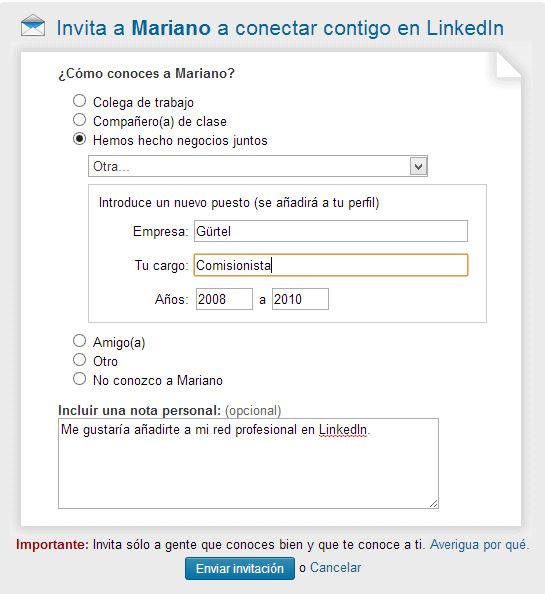
Hace unos días, un amigo me comentó que le había pedido el contacto en Linkedin a Mariano Rajoy y que lo había aceptado. Me picó la curiosidad y empecé a buscar perfiles públicos de políticos en Linkedin, empezando por el propio Rajoy. Lo primero que encontraremos, en gente que se supone que vive públicamente, es que ninguno de los más conocidos aparece como Open Networker y acceder a ellos supone realizar complicados equilibrios y facilitar que algún periodista, en un ataque de creatividad, pudiera publicar algo como esto que, como carnaza, no está nada mal:

Invitación a Rajoy

Con esa salvedad, el perfil de Rajoy no es de los peores aunque tiene un detalle divertido: El periodo comprendido entre 1986 y 1989, fecha de la fundación del PP, aparece en su perfil como «miembro del Congreso de los Diputados» sin referencia alguna a Alianza Popular por aquello de los complejos centristas.

Rosa Díez tiene en su perfil 135 míseros contactos, lo que deja claro que no utiliza Linkedin como vehículo de comunicación pero, eso sí, todavía supera y por mucho a su competencia más directa, Albert Rivera que tiene ¡¡¡2!!! contactos, no tiene siquiera una URL personalizada y la redacción de su perfil no pasaría un examen de primaria con joyas como ésta:  Habla catalán y castellano y tiene el nivel Advanced de inglés obtenido a la escuela de idiomas de Esade. Pues bien, incluso Albert Rivera supera a Esperanza Aguirre que tiene CERO contactos. ¿Para qué está en Linkedin entonces?

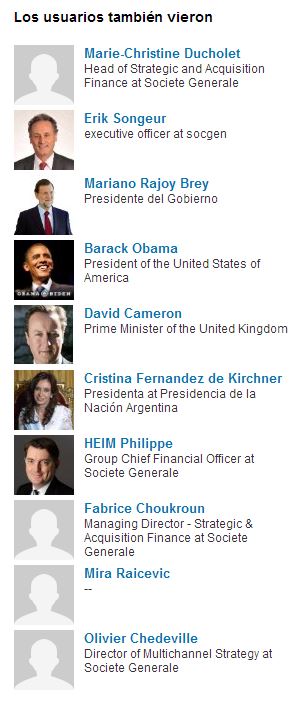
Algo más afinado está el perfil de María Dolores de Cospedal aunque sus 81 contactos sugieren que tampoco en su caso Linkedin es una vía de comunicación preferente. Por cierto, detalle simpático: Cuando se ven estos perfiles, no se piense que Linkedin los está homologando con otros políticos extranjeros sino que la información de Los usuarios también vieron saca a personajes como Cristiano Ronaldo, Lionel Messi o Risto Mejide. O Linkedin falla o no tienen un perfil muy claramente definido, dando lugar a este tipo de comparaciones.

La conclusión más obvia es que, si alguien busca hacer de la actividad política una profesión, al menos en España Linkedin no parece la vía más adecuada. En el extranjero, con variaciones, las cosas cambian. El perfil de Angela Merkel, también sin contactos, no tiene compañeros de viaje del mundo de la farándula:

Merkel

También fuera de nuestras fronteras, Obama es ya otro mundo. Además de sus casi 900.000 seguidores en Linkedin, quienes han visto su perfil han visto también estos otros:

ObamaNo es lo mismo ¿verdad? Añadamos que todos los movimientos que está haciendo Linkedin se van acercando más a convertirla en una red generalista aunque manteniendo una orientación clara al ámbito profesional o, dicho de otra forma, no es un portal de empleo ni un sitio donde sólo están los que buscan trabajo. ¿Entendido, señores políticos? Pues hala…trabajen un poco que no es malo.